HealthcareEmployer Benefits & ACA
GLP-1 medical savings covered 71% of drug costs by year 3
In Aetna claims, CVS Health found GLP-1 starters cost $13,300 more in drugs by year 3 and $9,400 less in medical care. CVS puts break-even near $350 a month.
Aetna commercial members who started a GLP-1 drug cost about $3,900 more per member than similar non-users by year 3, a CVS Health white paper published in November 2026 says. Drug spending was $13,300 higher per member and medical spending was $9,400 lower. CVS says a net price of about $350 a month over three years would bring the two into balance.
Medical savings grew in each yearly analysis but stayed below added drug spending in every group. For all initiators, medical savings equaled 22% of added drug spending in year 1, 35% in year 2 and 71% in year 3, Health and Tech Now math on CVS’s figures. For adherent members, those shares were 49%, 59% and 64%. Members who stayed on the drug recorded larger medical savings. They also carried a larger net cost, because they used more of the drug. For adherent members in year 3, medical spending was $13,000 lower and drug spending was $20,300 higher, a net increase of about $7,300 per member.
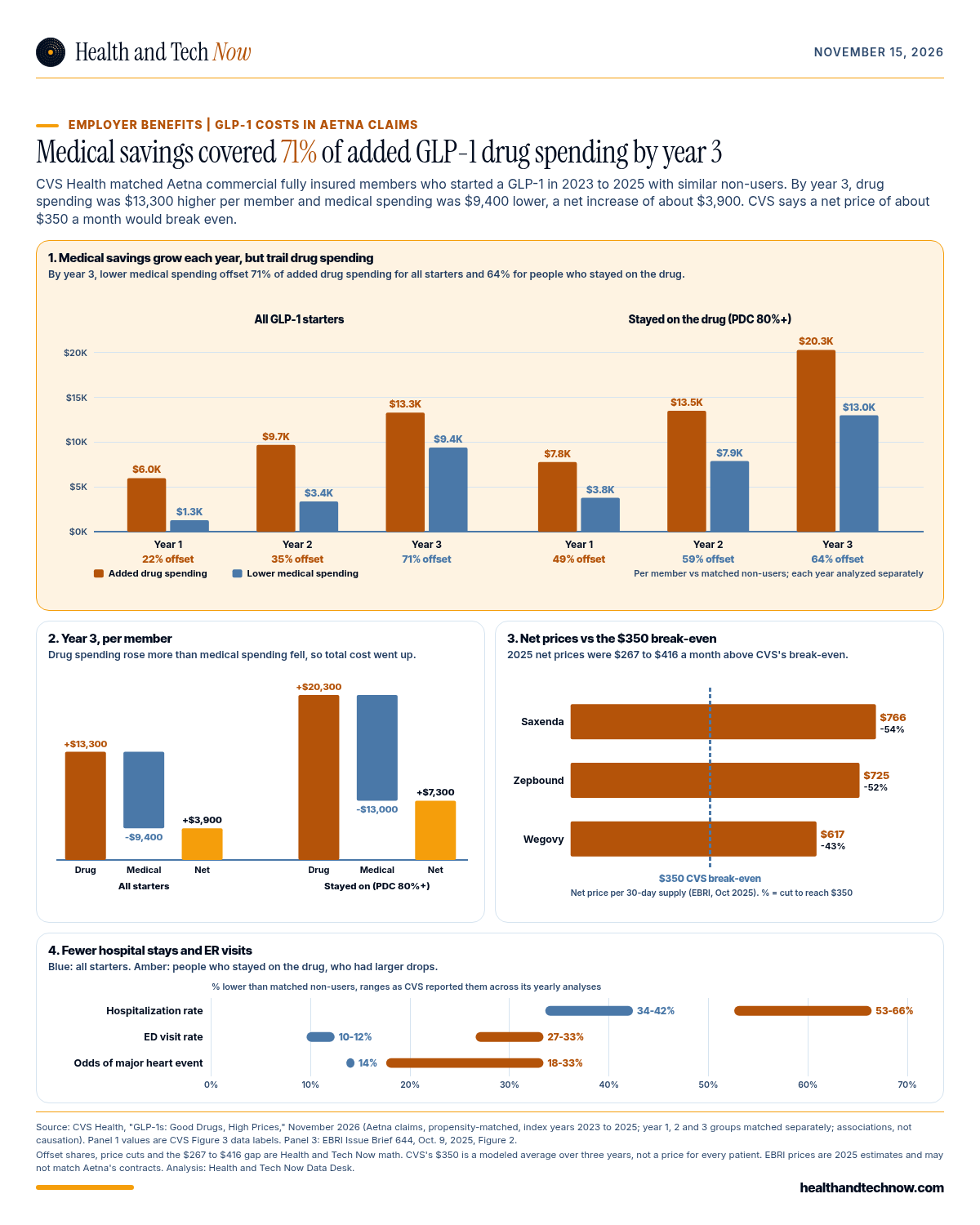
The $350 figure is a population average modeled over three years, not a price recommendation, CVS said. An October 2025 Employee Benefit Research Institute brief put net prices for a 30-day supply at $617 for Wegovy, $725 for Zepbound and $766 for Saxenda. That is $267 to $416 a month above $350. Reaching $350 would take a cut of 54% for Saxenda, 52% for Zepbound and 43% for Wegovy, Health and Tech Now math on EBRI’s figures. The EBRI prices are 2025 estimates from a different source and date, and they may not match Aetna contracts.
CVS reported lower use of care across the study period. Hospitalization rates were 34% to 42% lower for all initiators and 53% to 66% lower for adherent members. Emergency department visit rates were 10% to 12% lower for all initiators in years 1 and 2 and 27% to 33% lower for adherent members. Odds of major adverse cardiovascular events were 14% lower for all initiators in earlier year analyses and 18% to 33% lower for adherent members.
The study covers Aetna commercial fully insured members across index years 2023 to 2025, with up to three years of follow-up. CVS matched initiators to non-users one to one on propensity scores, and matched each year group separately. The company states several limits. The results show associations, not causation. The year 3 sample is smaller than the earlier samples. The $350 figure is a modeled average.
CVS released the findings in a press release on Nov. 15.

 data.healthcare.gov

 Georgetown Law

 download.cms.gov