FDA approves Gazyva as the first drug for primary membranous nephropathy
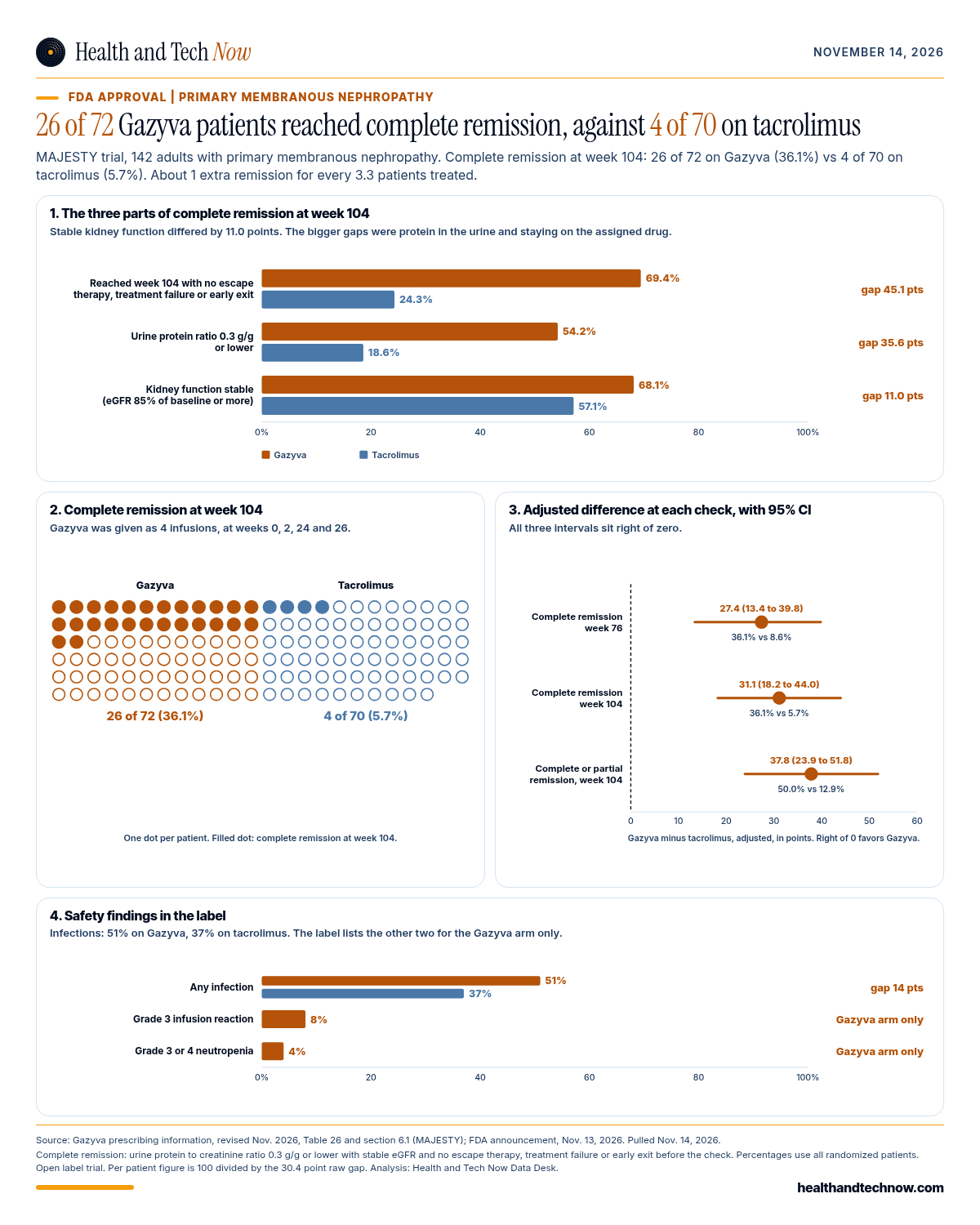
In the MAJESTY trial, 26 of 72 Gazyva patients reached complete remission at week 104, against 4 of 70 on tacrolimus. Only 24.3% of tacrolimus patients reached week 104 with no escape therapy, treatment failure or early exit.
The FDA approved Gazyva on Nov. 13, per the agency’s announcement. It covers adults with primary membranous nephropathy who are at risk of the disease getting worse. The goal is remission of protein in the urine. The FDA says Gazyva is the first drug approved specifically for this disease.
The FDA reported complete remission at week 104 in 36% of Gazyva patients and 6% of tacrolimus patients. The updated label shows where that gap came from.
A complete remission had to meet three conditions at week 104. Urine protein had to be 0.3 g/g or lower. Kidney function had to stay stable. And the patient could not have had escape therapy, treatment failure or an early exit from the study.
Per the label, kidney function held steady at similar rates in both arms, 68.1% on Gazyva and 57.1% on tacrolimus. The larger gaps were in the other two conditions.
In the label’s counts, 54.2% of Gazyva patients reached the urine protein target, against 18.6% on tacrolimus. And 69.4% of Gazyva patients reached week 104 with no escape therapy, treatment failure or early exit, against 24.3% on tacrolimus.
Counted by patient, 26 of 72 on Gazyva were in complete remission at week 104, against 4 of 70 on tacrolimus. That is about 30 more in 100, or one extra remission for every 3.3 patients treated.
The FDA announcement does not break out the three conditions or the patient counts. Both come from Table 26 of the label, revised in November 2026.
What the data shows
The disease
Primary membranous nephropathy is a rare kidney disease. The immune system attacks the glomeruli, the small filters that clean the blood, per the FDA. The filters leak large amounts of protein into the urine. Patients can develop swelling, high cholesterol, high blood pressure, fatigue and kidney failure.
Genentech said in July that up to 30% of untreated patients progress to kidney failure over 10 years, per its release. Gazyva was already approved for some blood cancers, active lupus nephritis and childhood onset idiopathic nephrotic syndrome, per the FDA.
What the trial found
MAJESTY randomized 142 adults to Gazyva or tacrolimus, per the FDA. The label lists 72 on Gazyva and 70 on tacrolimus. The study was open label and ran 104 weeks.
Gazyva patients got four 1,000 mg infusions, at weeks 0, 2, 24 and 26, per the label. Tacrolimus patients took the drug daily through week 52, then tapered off over 8 weeks. Tacrolimus is sometimes used off label for this disease, per the FDA.
The adjusted difference in complete remission at week 104 was 31.1 points (95% CI 18.2 to 44.0), per the label. The p value was below 0.0001. Complete or partial remission at week 104 was 50.0% on Gazyva and 12.9% on tacrolimus. Complete remission at week 76 was 36.1% and 8.6%.
Safety
Gazyva’s label carries a boxed warning for hepatitis B reactivation and progressive multifocal leukoencephalopathy, a rare brain infection, per the FDA. The most common side effects in the study were infusion reactions and upper respiratory tract infections.
Infections were reported in 51% of Gazyva patients and 37% of tacrolimus patients, per the label. Grade 3 infusion reactions occurred in 8% of Gazyva patients. Grade 3 or 4 neutropenia, a low count of a type of white blood cell, occurred in 4%.
What is not in the data yet
The label’s efficacy table does not report a long term kidney function result. Genentech had not posted a release on the approval as of 1 p.m. CT on Nov. 14.
Genentech’s July release put complete remission at 36.9% on Gazyva. The label’s Table 26 gives 26 of 72, or 36.1%. This story uses the label.
The FDA granted the application Breakthrough Therapy, Orphan Drug and Priority Review designations.



 NIH
 CIDRAP