FDA approves Imfinzi plus Padcev before bladder surgery for patients who cannot take cisplatin
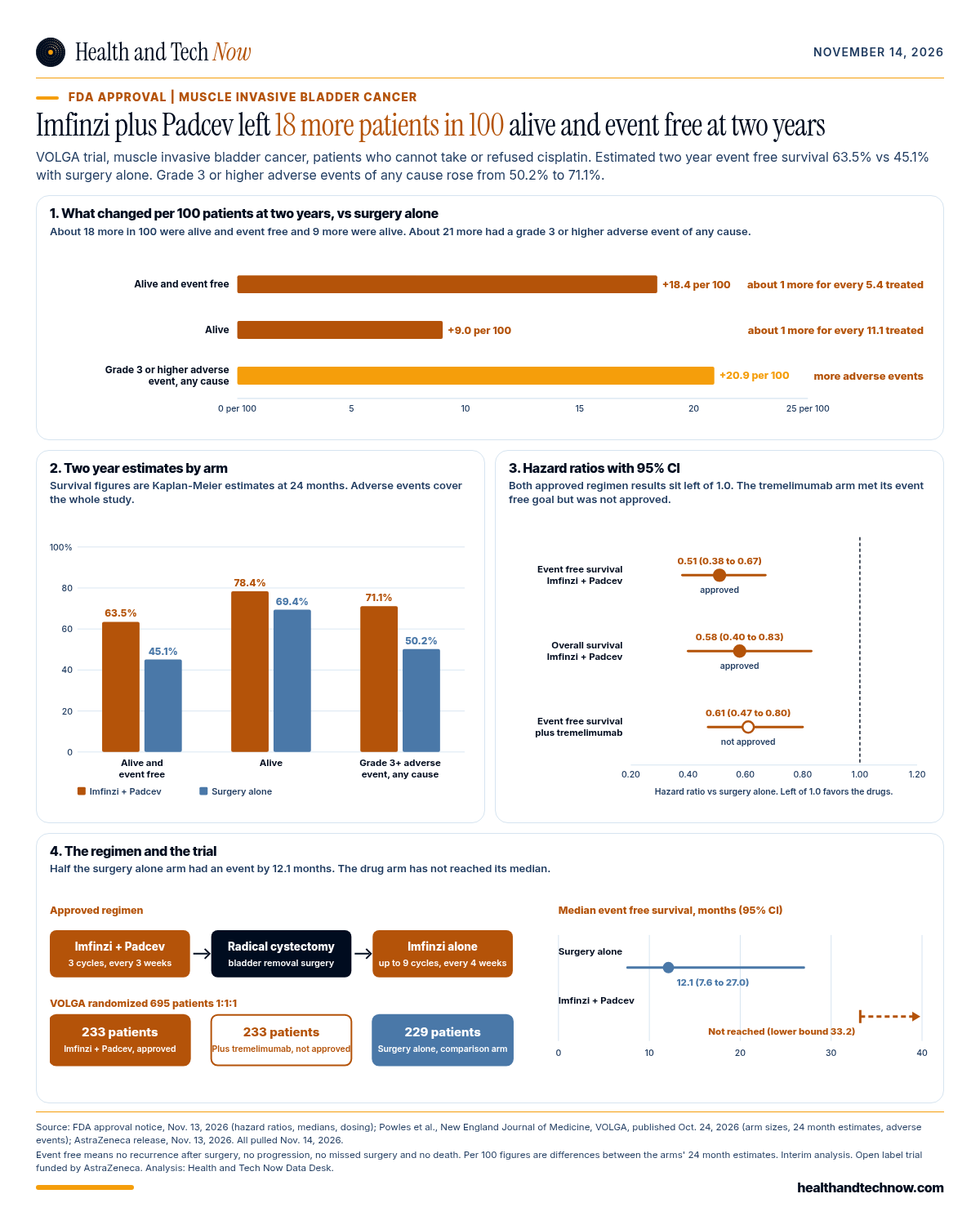
In the VOLGA trial, about 18 more patients in 100 were alive and event free at two years than with surgery alone. About 21 more in 100 had a grade 3 or higher adverse event of any cause.
The FDA approved AstraZeneca’s Imfinzi with Padcev on Nov. 13, per the agency’s approval notice. It covers adults with muscle invasive bladder cancer who cannot take cisplatin chemotherapy or have refused it. Patients get the pair before surgery to remove the bladder. After surgery they get Imfinzi alone.
Here is what the trial result means per 100 patients. In the VOLGA trial, an estimated 63.5% of patients on the drugs were alive and event free at two years, per the results in the New England Journal of Medicine. With surgery alone, the figure was 45.1%. That is about 18 more patients in 100, or about one more for every 5.4 treated.
The survival gain is smaller. An estimated 78.4% of patients on the drugs were alive at two years, against 69.4% with surgery alone, per the journal paper. That is 9 more patients in 100.
The regimen also brings more harm. Grade 3 or higher adverse events of any cause hit 71.1% of patients on the drugs and 50.2% with surgery alone, per the journal paper. That is about 21 more patients in 100.
The paper puts the rate tied to the treatment itself at 30.7%.
The FDA notice reports hazard ratios and medians. It does not give these per 100 figures. We worked them out from the two year estimates in the journal paper.
What the data shows
Who the approval covers
The approval covers adults with muscle invasive bladder cancer who are ineligible for cisplatin based chemotherapy or who refused it, per the FDA. In this cancer the tumor has grown into the muscle wall of the bladder.
Patients who weigh 30 kg or more get Imfinzi 1,500 mg every 3 weeks. They also get Padcev 1.25 mg/kg on days 1 and 8 of each cycle. That runs for 3 cycles before surgery. After surgery, Imfinzi 1,500 mg runs every 4 weeks for up to 9 cycles.
The FDA approved the application six weeks ahead of its goal date under priority review. The agency says the full Imfinzi label will be posted on Drugs@FDA.
AstraZeneca says about 16,000 patients will be treated for muscle invasive bladder cancer in the US in 2026, per its release. The company says as many as 50% of patients cannot take cisplatin because of kidney function or other conditions.
What the trial found
VOLGA randomized 695 patients into three arms of equal size, per the FDA. The journal paper lists 233 patients on Imfinzi plus Padcev, 233 on the same drugs plus tremelimumab, and 229 on surgery alone. The tremelimumab arm is not part of this approval.
The main measure was event free survival. An event was a recurrence after surgery, progression before surgery, failure to have surgery with disease left behind, or death.
The hazard ratio was 0.51 (95% CI 0.38 to 0.67), per the FDA. AstraZeneca describes that as a 49% lower risk.
Half the patients on surgery alone had an event by 12.1 months (95% CI 7.6 to 27.0). On the drugs, fewer than half had an event when the data were cut, so no median exists yet. The lower bound of its confidence interval is 33.2 months.
Overall survival also improved. The hazard ratio was 0.58 (95% CI 0.40 to 0.83), with a two sided p value of 0.0027, per the FDA. Neither arm has reached a median.
AstraZeneca describes that as a 42% lower risk of death.
The tremelimumab arm also beat surgery alone on event free survival, per the journal paper. Its hazard ratio was 0.61 (95% CI 0.47 to 0.80). Its adverse event rate of grade 3 or higher was 79.5%.
AstraZeneca’s release rounds the two year figures to 64% vs 45% event free and 78% vs 69% alive. It reports grade 3 and 4 adverse events at 64% vs 44%. The journal paper’s 71.1% and 50.2% count grade 3 or higher.
Limits
The trial was open label, so patients and doctors knew who got which treatment. These results come from an interim analysis. AstraZeneca funded the study.
The two year figures are Kaplan-Meier estimates, not raw counts, so the per 100 figures are estimates too. The patients on surgery alone got no drug before surgery. AstraZeneca says that arm could get approved treatment after surgery.


 NIH

 CIDRAP