HealthcareEmployer Benefits & ACA
Centene sets the ACA benchmark in 873 HealthCare.gov counties for 2027
We ranked every silver plan in CMS's 2027 plan files. Centene's Ambetter is the benchmark in 873 of 2,019 HealthCare.gov counties, up from 682, and the cheapest silver plan in 903. Its price now sets the tax credit math in more than four in ten counties.
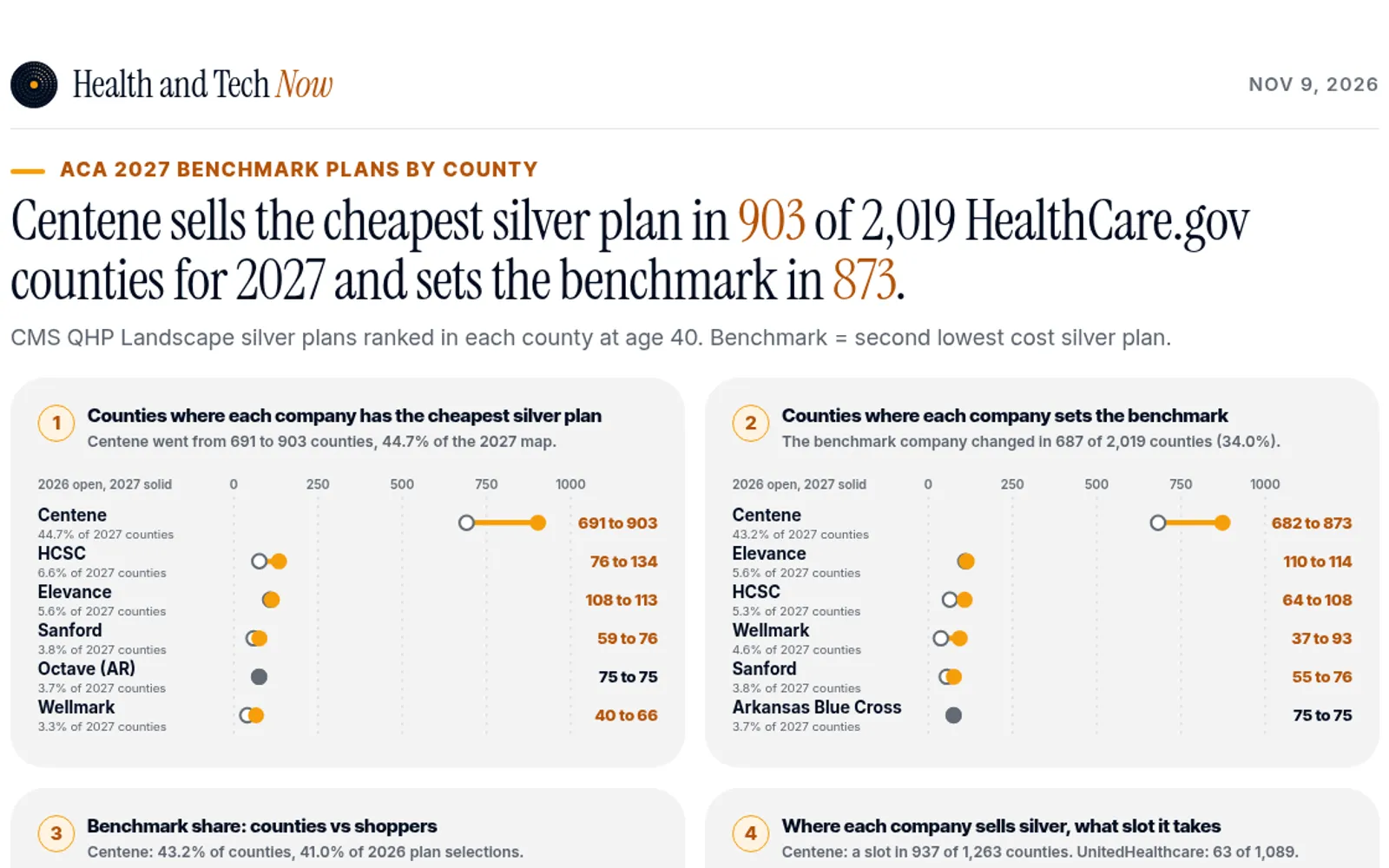
Centene’s Ambetter plans will set the benchmark silver price in 873 of 2,019 HealthCare.gov counties for 2027, up from 682 this year. Ambetter also sells the cheapest silver plan in 903 counties, up from 691. That is our count from CMS’s 2027 and 2026 plan files, which list every silver plan and its price in every county.
The benchmark is the second lowest cost silver plan in a county. Federal tax credits are measured against it. In 43.2% of HealthCare.gov counties next year, that number is an Ambetter price, no matter which company a shopper actually buys from.
What the data shows
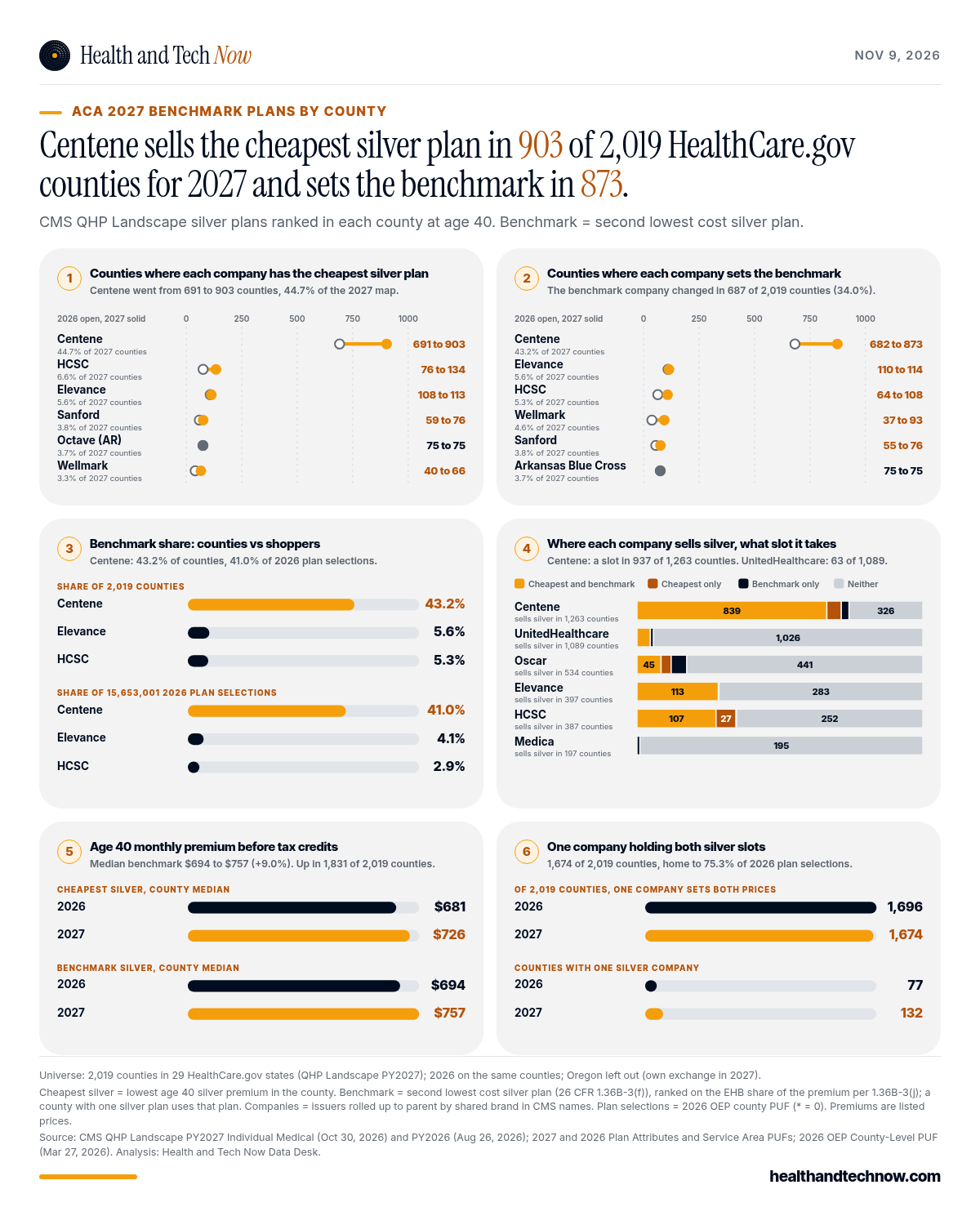
Centene has the cheapest silver plan in 44.7% of the 2027 map and the benchmark in 43.2%. No other company is close. The next biggest benchmark holders are Elevance (Anthem, Wellpoint) in 114 counties, the Blue Cross plans run by HCSC in Texas, Oklahoma and Montana in 108, and Wellmark in 93.
The benchmark company changed in 687 of the 2,019 counties, 34.0% of the map. Centene took the slot from another company in 275 counties and lost it in 84.
The biggest Centene gains are in the South and Ohio. In Tennessee it goes from 32 benchmark counties to 86, of 95. In Texas, 83 to 130, of 254. In Ohio, 5 to 39, of 88. In Alabama, 22 to 47, of 67. It loses ground in Oklahoma, 37 to 23.
The 873 Centene benchmark counties were home to 6.4 million of the 15,653,001 people who picked a HealthCare.gov plan in those 2,019 counties during 2026 open enrollment, or 41.0%. That measures where shoppers live, not who they bought from. CMS has not published 2027 sign-ups by company and county.
Selling in a county is not the same as winning it
Centene sells silver in 1,263 HealthCare.gov counties and holds the cheapest or benchmark slot in 937 of them. UnitedHealthcare sells silver in 1,089 counties, the second biggest footprint, and holds a slot in 63. Its benchmark count falls from 95 to 63, and its cheapest-plan count from 62 to 51.
In most counties one company now owns both prices. The same company has the cheapest silver plan and the benchmark in 1,674 counties, home to 75.3% of 2026 plan selections. That was 1,696 counties in 2026. Counties with only one company selling silver rise from 77 to 132.
Prices before tax credits
For a 40-year-old buying alone, the county median cheapest silver plan rises from $681 a month to $726, up 6.6%. The median benchmark rises from $694 to $757, up 9.0%. The benchmark goes up in 1,831 of the 2,019 counties.
These are listed prices before tax credits, and they are plain county medians, so a small rural county counts the same as Harris County, Texas. KFF, using a different method, puts the average 2027 benchmark increase in HealthCare.gov states at 11%.
The gap between the cheapest silver plan and the benchmark also widens. At the county median it goes from $9.53 a month to $16.65 for a 40-year-old.
Why it matters
The tax credit is the benchmark price minus what the law says a household should pay. When one company prices both the cheapest plan and the benchmark in a county, that company sets the spread a subsidized buyer gets to keep by choosing the cheaper plan. In 2027 that company is usually Centene.
It also means a shopper’s credit can move even if they keep the same plan. In the 687 counties where the benchmark company changed, the credit is now pegged to a different company’s price.
Footprint alone does not explain it. UnitedHealthcare sells silver in almost as many counties and rarely prices low enough to set the benchmark. For 2027, the subsidy math on HealthCare.gov runs mostly through one company’s rate filings.
How we counted
- Counties. HealthCare.gov (federally facilitated) counties only: every county in the QHP Landscape PY2027 Individual Medical file, 2,019 counties in 29 states. States that run their own exchanges are not in the file. The 2026 file has 2,055 counties in 30 states. Oregon (36 counties) runs its own exchange for 2027, so we left it out of the 2026 comparison and both years use the same 2,019 counties.
- Cheapest silver. The silver plan with the lowest listed premium for a single adult age 40 in the county.
- Benchmark. The second lowest cost silver plan under 26 CFR 1.36B-3(f), ranked on the essential health benefits portion of the premium. A county with only one silver plan uses that plan. CMS does not flag the benchmark in this file; this is our ranking of the CMS premium columns. There were no ties between companies for either slot in either year.
- Companies. Issuers are grouped by the shared brand in CMS’s marketing names in the Plan Attributes file (Ambetter = Centene; Anthem and Wellpoint = Elevance). Ownership that CMS names do not show is not used. In Arkansas, Octave is the cheapest silver plan in all 75 counties and Arkansas Blue Cross and Blue Shield is the benchmark in all 75. CMS names do not show shared ownership, so we count them as separate companies.
- Shoppers. The weights are 2026 open enrollment plan selections by county from the 2026 OEP County-Level PUF, because 2027 enrollment by company and county is MISSING: CMS has not published it. Two suppressed cells count as zero.
- Checks. We reopened every CMS file on Nov. 9, 2026 and confirmed it matches the version on the CMS server, then recounted every headline number from scratch.
 CMS, QHP Landscape PY2027 Individual Medical (data.healthcare.gov, updated Oct 30, 2026; data as of Oct 20, 2026)
- CMS, QHP Landscape PY2026 Individual Medical (data.healthcare.gov, updated Aug 26, 2026)
 CMS, 2027 Plan Attributes public use file (posted Oct 30, 2026)
- CMS, 2027 Service Area public use file (posted Oct 30, 2026)
- CMS, 2026 Plan Attributes public use file (posted Aug 10, 2026)
- CMS, 2026 Service Area public use file (posted Aug 10, 2026)
 CMS, 2026 Open Enrollment Period County-Level public use file (Mar 27, 2026)
 26 CFR 1.36B-3, Computing the premium assistance credit amount (eCFR)
 KFF, 9 Things to Watch for the 2027 ACA Open Enrollment Period, Oct. 30, 2026
 Georgetown Law