HealthcareHealthcare & Insurance
Insurers left nearly 30% of surprise billing awards unpaid
A New York Times analysis of 400,000 No Surprises Act arbitration awards finds Anthem unpaid on 74% since 2024. The Labor Department is investigating Anthem, and the $100 a day federal fine has never been used.
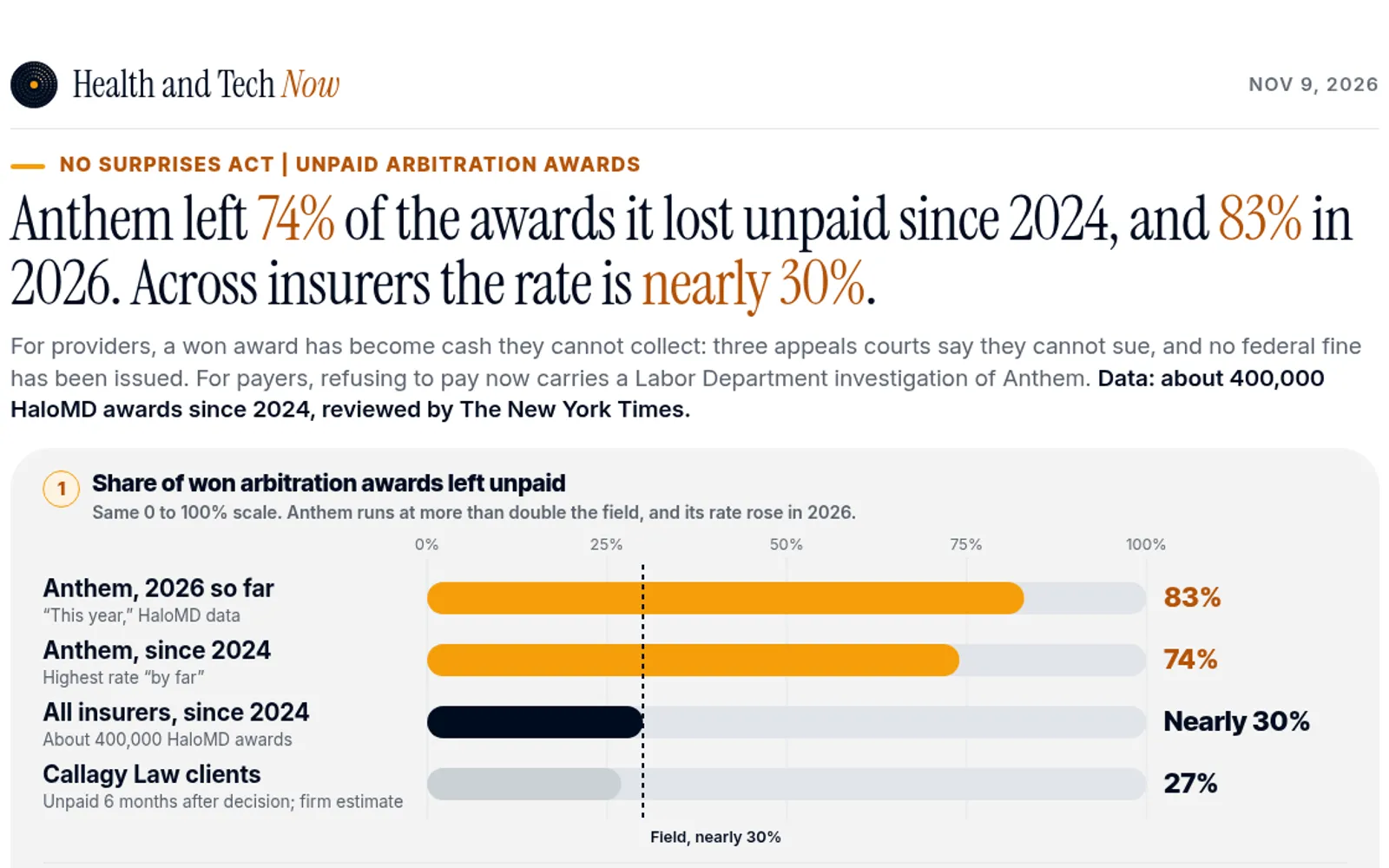
Nearly 30% of No Surprises Act arbitration awards have gone unpaid since 2024, according to a New York Times analysis of 400,000 awards, published Nov. 3, 2026. The awards come from HaloMD, a medical billing firm. Anthem leads the field, with a nonpayment rate of 74% since 2024.
The Times reviewed data covering about two thirds of the awards HaloMD has won since 2024. The data include only cases where payments could be reliably tracked.
What the data shows
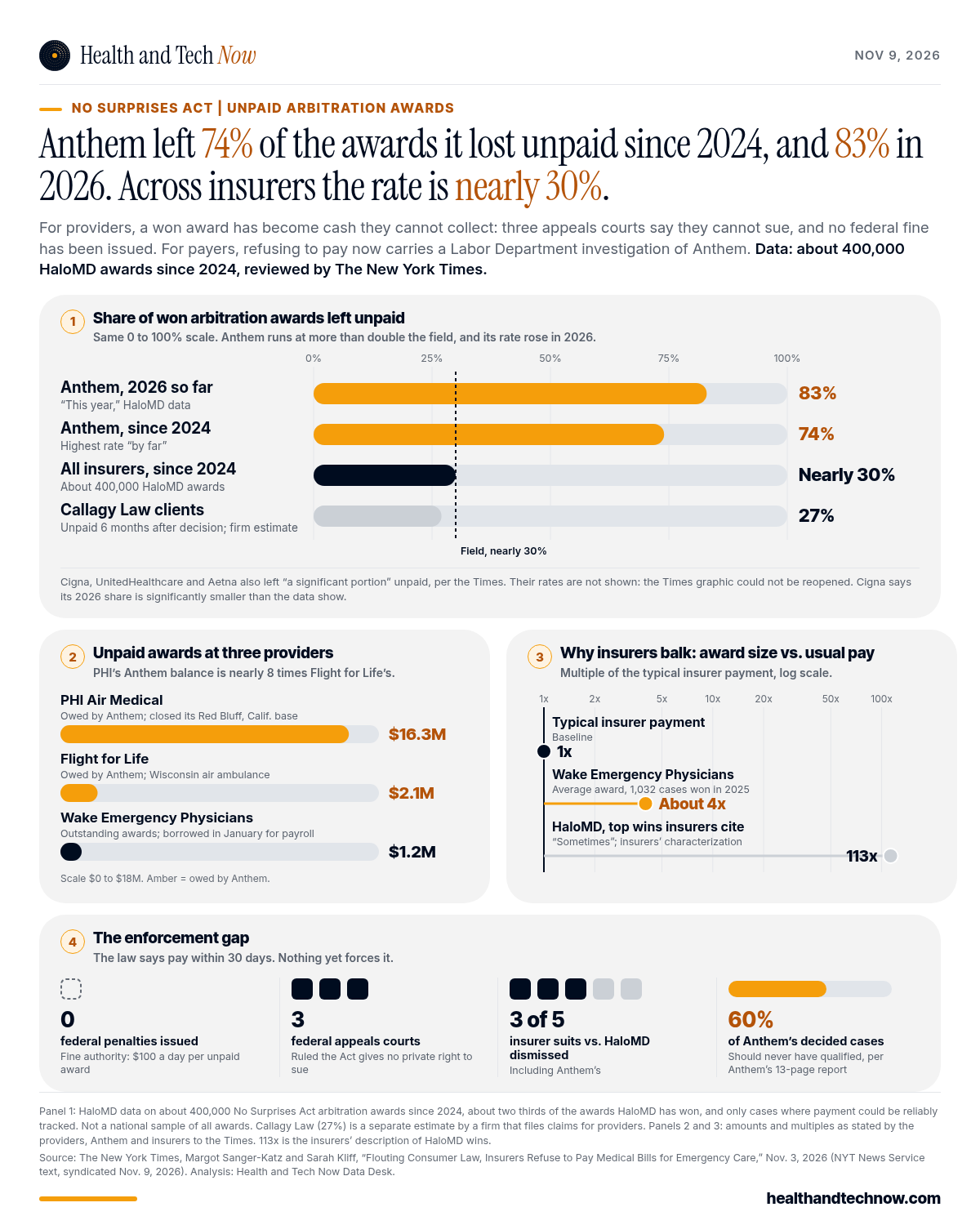
Anthem has not paid 83% of arbitration claims this year, per the HaloMD data. Cigna, UnitedHealthcare and Aetna also declined to pay significant portions. A Cigna spokesperson told the Times a significantly smaller share went unpaid in 2026 than the Halo data showed. Only one of the major insurers the Times contacted disputed the data’s accuracy.
Anthem has refused to pay $2.1 million owed to Flight for Life, a Wisconsin air ambulance service. Per-flight amounts range from $9,382 to $62,373. Anthem says Flight for Life violated arbitration procedural rules. Flight for Life disputes that.
PHI Air Medical CEO Scott McCarty cited $16.3 million outstanding from Anthem as the reason it closed a base in Red Bluff, California. Anthem spokesperson Janey Kiryluik said the company is trying to bring PHI into network and that PHI requests unreasonably high rates, typically $56,000 per flight in arbitration.
The insurer case
Most large insurers told the Times their policy is not to pay awards if they believe the claim should never have qualified for arbitration. Anthem issued a 13-page report estimating 60% of decided cases should never have qualified. Ariel Bayewitz, Elevance vice president of health economics, told the Times the company believes strongly in paying eligible awards on time.
Insurers also say HaloMD submits unreasonably high bids, sometimes winning 113 times typical insurer payments. Five insurers sued Halo, and three cases were dismissed, including one from Anthem. HaloMD says the suits are an attempt to intimidate clinicians.
Who is stuck
Wake Emergency Physicians, based in North Carolina, has $1.2 million outstanding. It won 1,032 cases in 2025, with average awards about four times typical insurer payments. The group took a line of credit in January to make payroll.
Providers have filed hundreds of lawsuits to enforce awards. Callagy Law partner Thomas LaGreca estimates 27% of clients’ claims remain unpaid six months after decisions. Three federal appeals courts have ruled the Act has no private right to sue.
Enforcement and reform
The Labor Department is investigating Anthem’s failure to pay awards, per documents the Times obtained. Anthem says it is cooperating.
The law lets the government fine insurers $100 per day for each unpaid award. The administration has not issued a single penalty. A CMS spokesperson told the Times the law always requires insurers to pay awards. CMS and DOL declined to say why no penalties have been issued.
Sen. Bill Cassidy (R-La.), chair of the Senate Health Committee, wants to fix the law before leaving office in January. Rep. Frank Pallone Jr. (D-N.J.) introduced a bill last month to replace arbitration with a flat payment at the level insurers typically pay.
Why it matters
Payers now face public scrutiny of unpaid awards and an active Labor Department investigation. Providers hold awards that the law says must be paid, with a $100 per day fine authority that has never been used. The Cassidy push in January and the Pallone bill are the two live reform tracks. Operators with pending awards should watch both, plus any enforcement action from DOL.

 justice.gov

 Federal Register

 kffhealthnews.org