HealthcareHealthcare & Insurance
Year 2 rural health awards moved $68.0M between states
CMS posted Year 2 Rural Health Transformation awards for all 50 states. 25 states got more and 25 got less. North Dakota gained the most, Florida lost the most, and the Northeast was cut a net $18.4 million.
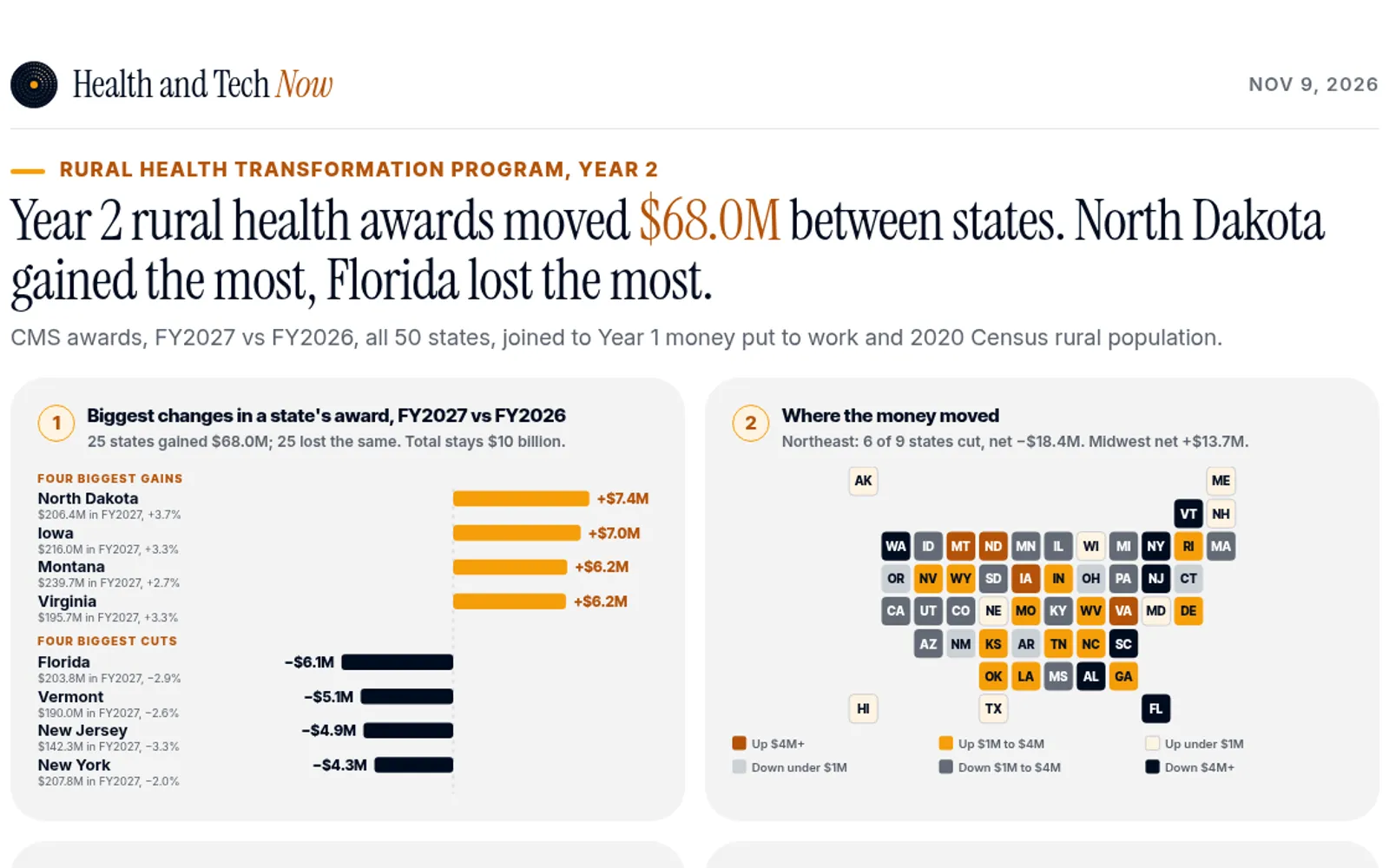
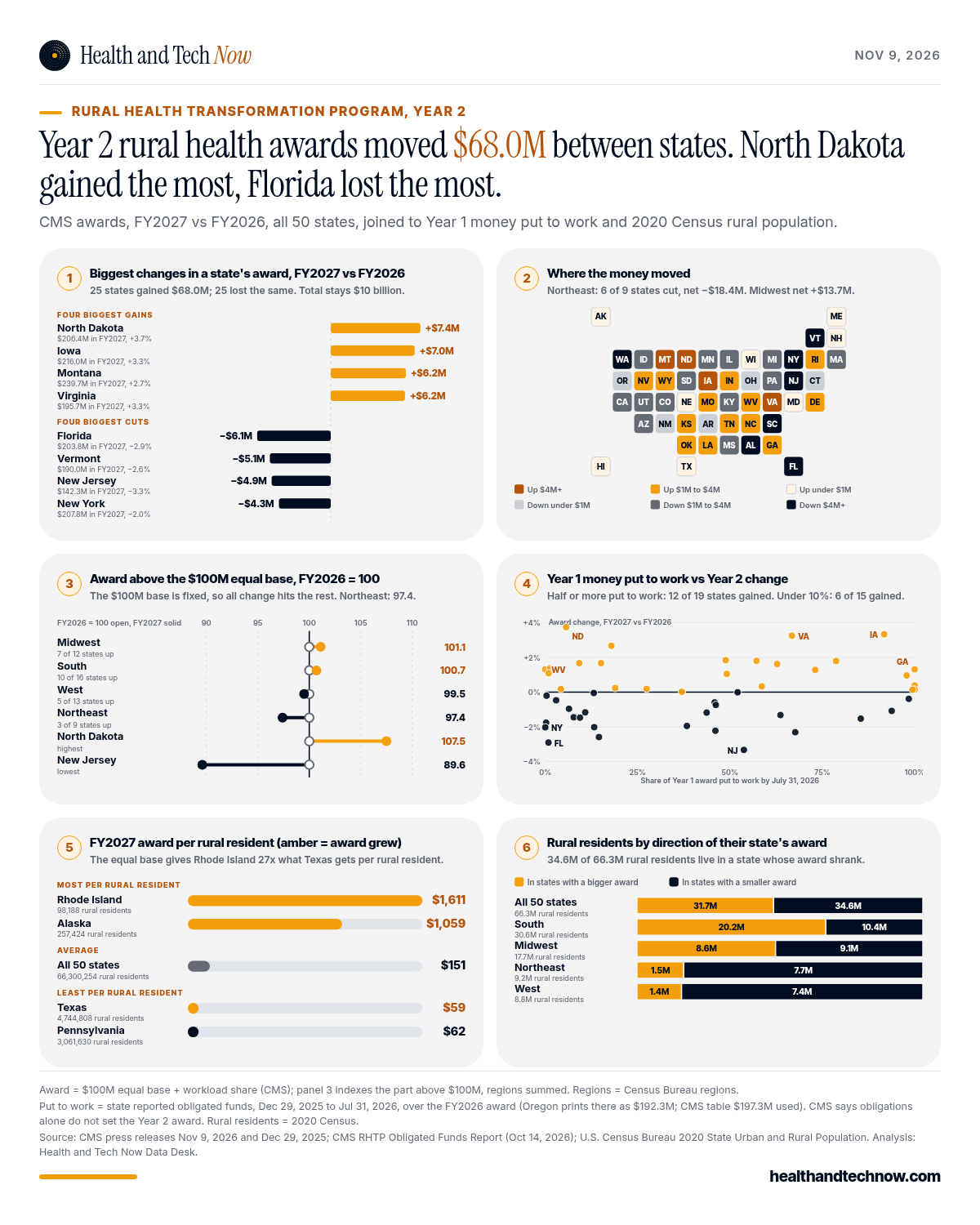
North Dakota, Iowa, Montana and Virginia got the biggest raises in Year 2 of the Rural Health Transformation Program. Florida, Vermont, New Jersey and New York took the biggest cuts. In all, $68.0 million moved between states, by our count from the Centers for Medicare & Medicaid Services (CMS) award tables.
CMS announced $10 billion in Year 2 awards to all 50 states on Nov. 9, 2026. The program is $50 billion over five years, $10 billion a year, so the total did not change. The split did. 25 states got more for FY2027 and 25 got less.
What the data shows
Who gained and who lost
North Dakota gained the most. Its award rose $7,442,657, or 3.7%, to $206.4 million. Iowa came next, up $7.0 million (3.3%) to $216.0 million. Montana and Virginia each rose $6.2 million.
Florida lost the most. Its award fell $6,110,124, or 2.9%, to $203.8 million. Vermont fell $5.1 million (2.6%), New Jersey $4.9 million (3.3%) and New York $4.3 million (2.0%).
No state moved more than 3.7% either way.
The Northeast took the biggest cut
CMS cut 6 of the 9 Northeast states, for a net loss of $18.4 million in the region. The Midwest came out $13.7 million ahead, with 7 of 12 states up. The South gained a net $11.7 million, with 10 of 16 states up. The West lost a net $7.1 million, with 5 of 13 states up.
Only the top half moves
Every state gets $100 million in equal baseline funding each year. CMS splits the other half as workload funding, using factors in the program’s funding notice. For Year 2, the CMS fact sheet says, that money is also informed by each state’s progress on its plan.
The $100 million base is fixed, so every dollar of change falls on the part above it. We indexed that part to FY2026 = 100. North Dakota is at 107.5, the highest. New Jersey is at 89.6, the lowest. By region, the Midwest is at 101.1, the South 100.7, the West 99.5 and the Northeast 97.4.
Year 1 spending was a loose guide
Nineteen states had put half or more of their Year 1 award to work by July 31, 2026, according to the program’s Obligated Funds Report. Twelve of them got more for Year 2. Of the 15 states that had put less than 10% to work, 6 got more.
New York and West Virginia both reported $0 put to work by July 31. CMS cut New York 2.0% and raised West Virginia 1.3%. The fact sheet says the obligation figures “do not, by themselves, measure a state’s overall progress or determine its Year 2 award.”
Where rural residents live
The 2020 Census counted 66.3 million rural residents in the 50 states. 34.6 million of them live in a state whose award shrank.
The equal base also means small states get far more per rural resident. Rhode Island gets about $1,611 per rural resident for FY2027. Texas gets about $59. Across all 50 states the figure is $151.
Why it matters
Year 2 is the first time state awards have changed from one year to the next. CMS says it measures progress with checkpoints, such as launching initiatives and reaching milestones. The award tables show each state’s new total. They do not show checkpoint scores, so these files do not explain any one state’s raise or cut.
The moves are small next to a $10 billion pot. They still set the budgets states have to plan around. The awards come after CMS delayed the competitive part of the 2027 money, as we reported Nov. 5.
How we counted
- Awards. We joined the CMS FY2027 state award table (Nov. 9, 2026) to the FY2026 table (Dec. 29, 2025) for all 50 states. The two tables sum to $10,000,000,001 and $10,000,000,003.
- Money moved. $68.0 million is the sum of every increase, $67,986,237. The decreases sum to $67,986,239. The $2 gap is rounding in the CMS tables. 25 states went up, 25 went down and none stayed flat.
- Index. Each award is a $100 million equal base plus a workload share. The index divides each state’s FY2027 award above $100 million by its FY2026 award above $100 million, with FY2026 = 100. Regions are Census Bureau regions, summed before indexing.
- Put to work. This is the obligated amount each state reported from Dec. 29, 2025 to July 31, 2026 in the CMS Obligated Funds Report (file dated Oct. 14, 2026). We divided it by the FY2026 award in the CMS table.
- Oregon. The obligated report lists Oregon’s Year 1 award as $192,271,577.67. The CMS award table shows $197,271,578. We used the table. Oregon put $102,723,439.06 to work either way, 52.1% on the table figure and 53.4% on the report figure. Both are over 50%, so the 12 of 19 and 6 of 15 counts do not change. The other 49 states match the table within $1.
- Rural residents. 2020 Census rural population by state. D.C. and Puerto Rico are not in the program and are left out.
- Enrollment. These are federal grants to state governments. No health plan enrollment data is used.
- Checks. We reopened every source on Nov. 9, 2026 and recounted each number from the source files.
 CMS, Trump Administration Announces $10 Billion in Second Year of Rural Health Transformation Awards to All 50 States (FY2027 state awards), Nov. 9, 2026
- CMS, Rural Health Transformation Program: Year 2 Awards (fact sheet), Nov. 9, 2026
- CMS, CMS Announces $50 Billion in Awards to Strengthen Rural Health in All 50 States (FY2026 state awards), Dec. 29, 2025
- CMS, Rural Health Transformation Program Obligated Funds Report (data as of July 31, 2026; file dated Oct. 14, 2026)
- U.S. Census Bureau, 2020 State Urban and Rural Population
 hawaiitribune-herald.com

 justice.gov

 Federal Register