58 million women's free screenings depend on guidelines HHS will now rewrite
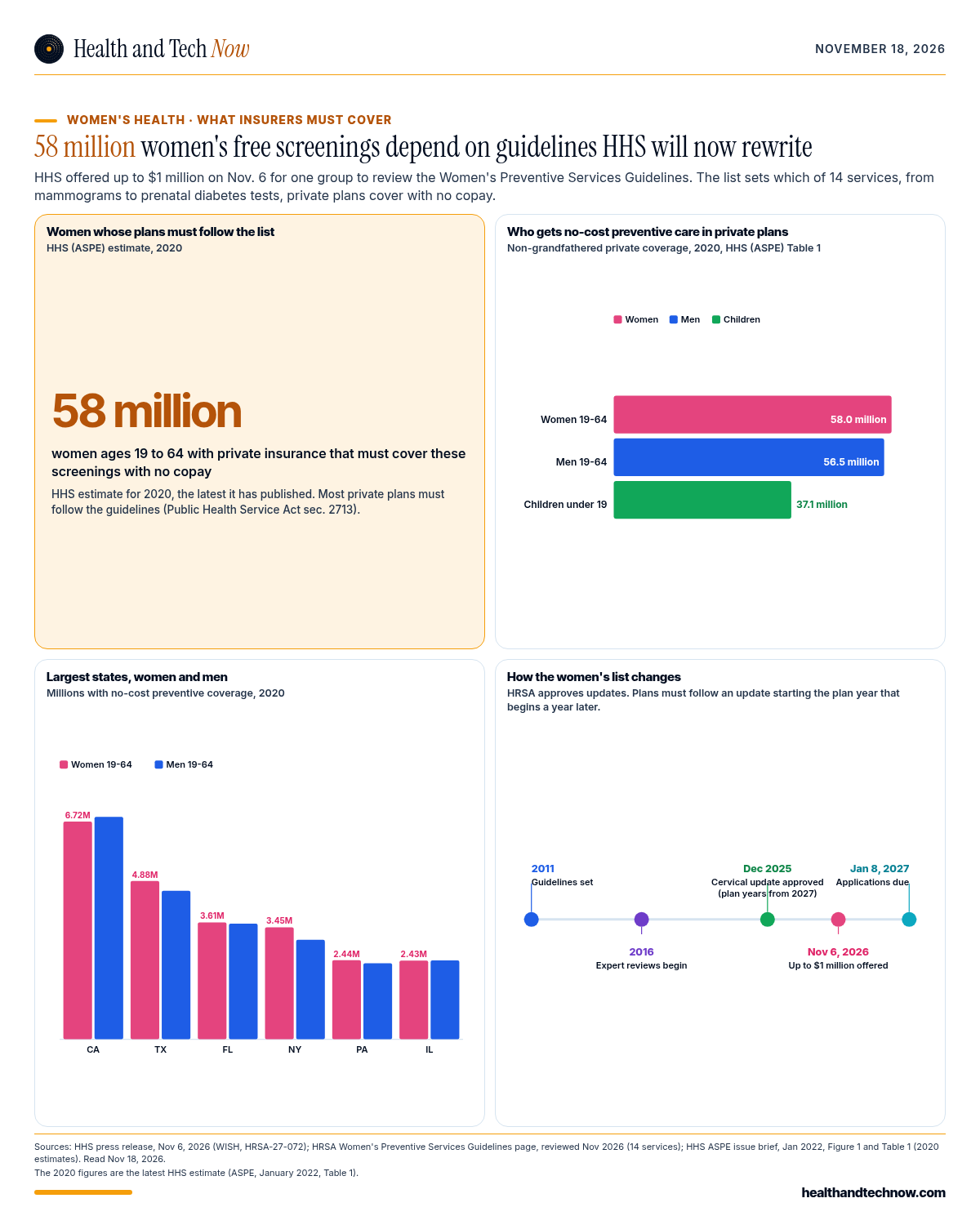
HHS offered up to $1 million on Nov. 6 for one group to review the 14 services private plans must cover for women with no copay. Applications due Jan. 8, 2027.
About 58 million women with private health insurance get a set of screenings with no copay because of one federal list, and HHS is now paying to rewrite it. On Nov. 6, HHS offered up to $1 million in fiscal 2027 to one organization that will review the Women’s Preventive Services Guidelines.
The guidelines matter to insurers and employers. Under the Public Health Service Act, most private plans must cover the services HRSA supports with no copay, deductible or coinsurance, HHS said. Plans that existed on March 23, 2010, and have not changed in certain ways since are exempt, HRSA says.
HRSA’s current list has 14 services. They include mammograms, cervical cancer screening, well-woman visits, contraception, breastfeeding support and supplies, screening for diabetes during and after pregnancy, and screening for anxiety, intimate partner violence and urinary incontinence.
HHS’s own estimate puts the women covered at 58.0 million for 2020, alongside 56.5 million men and 37.1 million children in private plans with no-cost preventive care. California had 6.72 million of those women, Texas 4.88 million and Florida 3.61 million. HHS has not published a newer count.
The winning group must convene a panel of at least 10 experts, review evidence to National Academies standards, and recommend updates or reaffirm the current list. HRSA then decides what to accept. Applications are due Jan. 8, 2027, on Grants.gov under HRSA-27-072.
Changes reach insurance cards slowly. A plan must follow an update starting with the plan year that begins one year after HRSA accepts it, HRSA says. Its most recent change, a cervical screening update that allows self-collected samples for women 30 to 65, applies to most plans starting in 2027.

 JAMA Network

 Nature