CMS proposes 15 star ratings measures for Medicare Advantage, estimates $107 billion in savings
The 2028 Medicare Advantage and Part D proposed rule would drop 19 star ratings measures and end the reward factor. CMS estimates the star changes would save Medicare $106.96 billion from 2028 through 2037. The rule also proposes the CMS Innovation Center's first mandatory Medicare Advantage model, in 12 randomly selected states from 2029.

The Centers for Medicare & Medicaid Services released its second proposed rule for the 2028 Medicare Advantage and Part D plan year on Nov 20. The rule, CMS-4214-P2, went on Federal Register public inspection at 5:13 PM ET and is scheduled to publish on Nov 25. The first 2028 rule, CMS-4214-P, came out on Oct 16, per the CMS fact sheet.
The largest dollar item is the star ratings. CMS would cut the measure set to 15 measures and remove the reward factor, per the fact sheet. The improvement measure hold harmless would apply only to contracts whose highest rating is 4.5 stars or more.
Star ratings
The rule proposes removing 19 measures, per page 229 of the public inspection PDF. That is on top of the 11 measures CMS removed in the 2027 final rule. The new removals would start with the 2028 measurement year and the 2030 star ratings. CMS says it may finalize all, some or none of the 19.
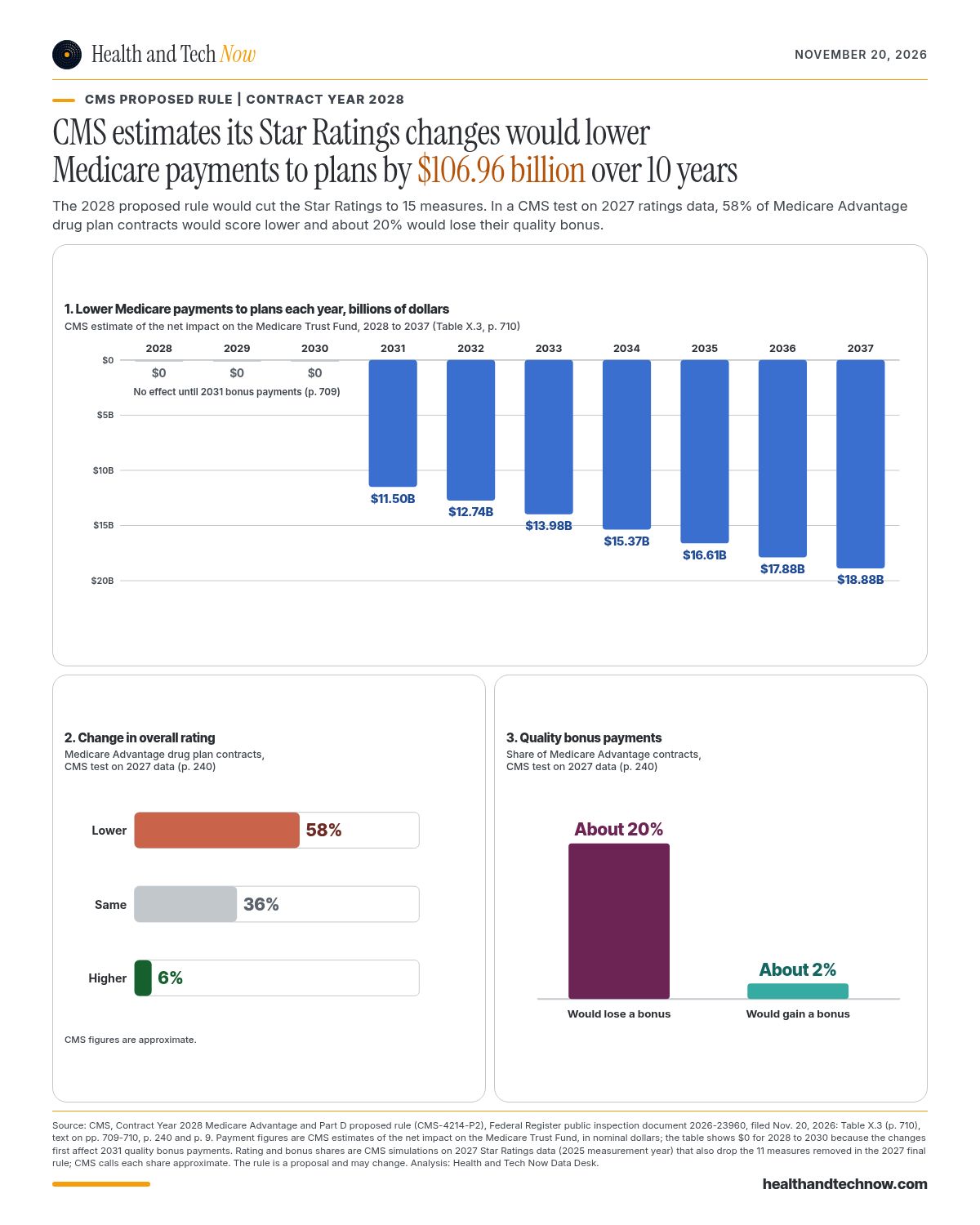
CMS ran the proposed changes on 2027 star ratings data, per page 240. About 58% of Medicare Advantage contracts with drug coverage would get a lower overall rating. About 6% would rise and about 36% would not change. About 20% of contracts would lose quality bonus payments and about 2% would gain them.
CMS estimates the star ratings changes would save the Medicare Trust Fund $106.96 billion from 2028 through 2037, per Table X.3 on page 710. The savings start in 2031 at $11.50 billion and reach $18.88 billion in 2037. That is 1.17% of Medicare payments to private health plans over the 10 years. Plans with 4 stars or more get a quality bonus payment. Plans with higher ratings also keep a larger share of savings as rebates, per the same section.
Neither the fact sheet nor the HHS release gives the dollar figure. It is in the rule’s regulatory impact analysis.
A mandatory model in 12 states
The rule proposes the ADVaNCE MA model, the CMS Innovation Center’s first mandatory Medicare Advantage model, per the fact sheet. It would run 10 years from 2029. A pre-implementation period would start June 8, 2027, the bid deadline for 2028 plans.
CMS would pick 12 states at random, 24% of eligible states, per page 485 of the PDF. All Medicare Advantage organizations with eligible plans in those states would have to take part. In those states a new Diamond Ratings system would replace the star ratings and quality bonus payments. The model would also shadow test a new risk adjustment method. Plans could offer food, transportation and caregiver benefits to enrollees who qualify for the Part D low income subsidy. CMS says it is considering, but not proposing, a carve-out of dialysis payment for enrollees with end-stage renal disease.
Other proposals
- Food benefits. Food in supplemental benefits would have to meet a CMS healthy food standard based on the current Dietary Guidelines for Americans, per the fact sheet. A provider can still recommend other items for an enrollee’s medical needs. Enrollees used the Food and Produce benefit for the chronically ill about 40 million times in 2025, per the HHS release.
- Networks. New plans and service area expansions would show network adequacy in their first year of operation instead of in the application.
- Disaster enrollment. Beneficiaries would need prior approval through 1-800-MEDICARE to use the disaster or emergency special enrollment period. CMS says data suggest plans may be using it to enroll people a disaster did not affect.
- Cost sharing. The emergency services cost sharing limit would be $180 to $240. Ground ambulance coinsurance would be capped at a $180 to $300 limit. Both ranges depend on the plan’s maximum out-of-pocket amount.
- Provider exits. Plans would notify enrollees when a provider termination affects at least 10% of enrollees or at least 10% of a specialty’s network. Plans would keep covering care from the terminated provider at in-network cost sharing for at least 90 days.
- Agents and brokers. CMS would end its compensation caps, renewal limits and referral fee caps. It would add market-based guardrails, more compensation reporting and a method to flag outlier payments.
- Prior authorization. In-network providers would have to send prior authorization requests through the plan’s FHIR-based Prior Authorization API.
CMS takes comments for 60 days, per the HHS release. Comments go to docket CMS-2026-3533 on regulations.gov. The Federal Register will show the exact deadline when it publishes the rule.
The 2027 star ratings are already in court. UnitedHealth sued CMS on Nov 19, the 16th insurer to sue over those ratings.
 CMS fact sheet: Contract Year 2028 Policy and Technical Changes to the Medicare Advantage Program, Medicare Prescription Drug Benefit Program, and Medicare Cost Plan Program (CMS-4214-P2), Nov 20, 2026
 Federal Register public inspection, document 2026-23960, filed Nov 20, 2026, 5:13 PM ET, scheduled to publish Nov 25, 2026 (868 pages)
 Proposed rule PDF, public inspection copy
 HHS press release: CMS Proposes Reforms to Strengthen Competition, Elevate Care Quality, and Expand Beneficiary Choice in Medicare Advantage, Nov 20, 2026
 Comment docket CMS-2026-3533, regulations.gov
- Photo license: Creative Commons Attribution 2.0, ajay_suresh, United States Department of Health and Human Services, Humphrey Building, June 21, 2024

 AMA

 Georgetown Law