Medicare Advantage market concentration rose in 2025 for the first time in the AMA's study
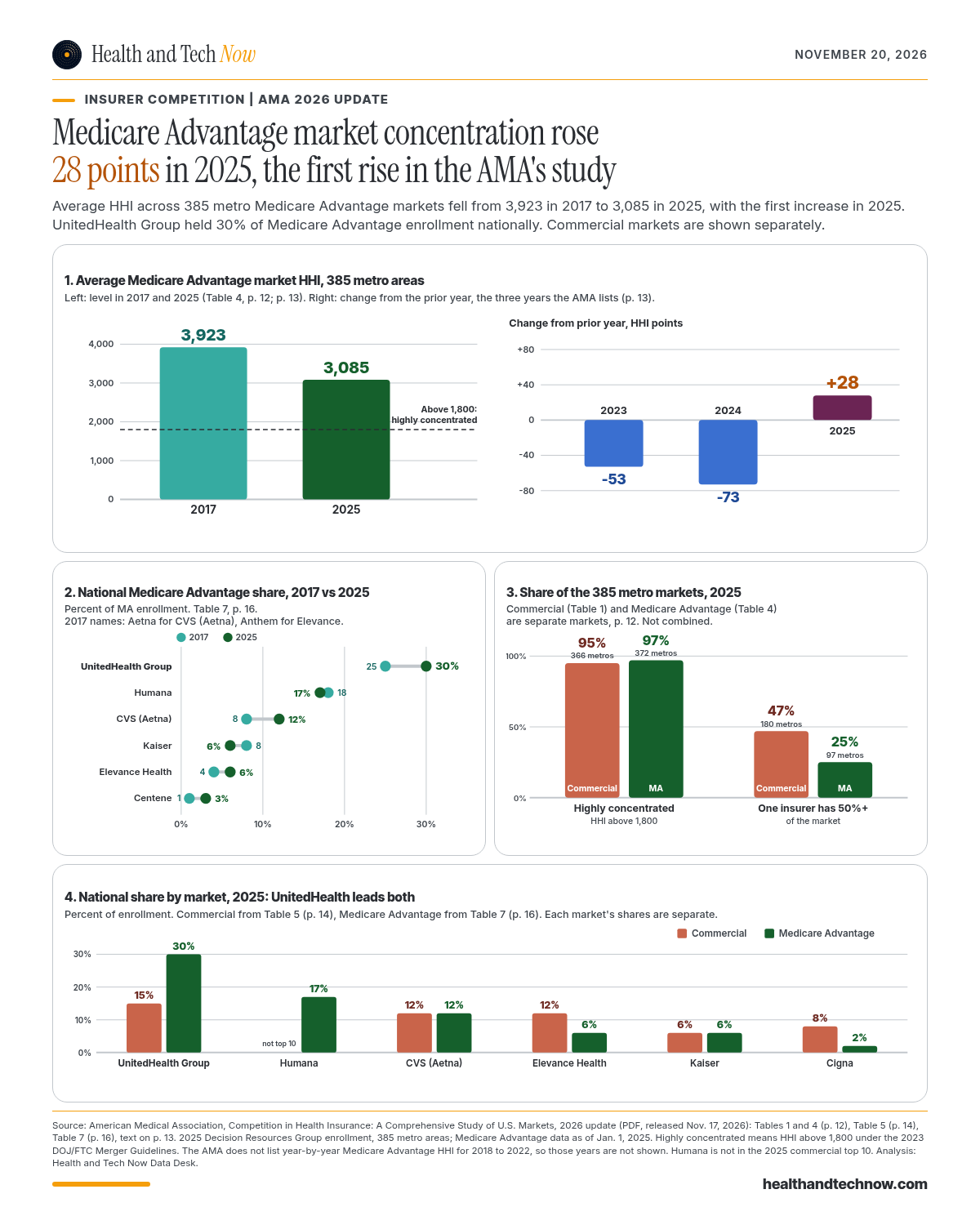
Average concentration across 385 metro Medicare Advantage markets rose 28 points in 2025 after falling every year since 2017, the American Medical Association's Nov. 17 study shows. 97% of those markets were highly concentrated. UnitedHealth Group held 30% of Medicare Advantage enrollment nationally.

Average concentration in metro Medicare Advantage markets rose 28 points in 2025, the American Medical Association’s annual insurer competition study shows. It is the first increase since the AMA began measuring Medicare Advantage markets this way in 2017, per page 13. The AMA released the 2026 update on Nov. 17.
It uses 2025 enrollment data from Decision Resources Group for 385 metro areas.
The study measures concentration with the Herfindahl-Hirschman Index, or HHI. Federal antitrust agencies use the same measure to review mergers. Under the 2023 Justice Department and Federal Trade Commission merger guidelines, a market with an HHI above 1,800 is highly concentrated.
Medicare Advantage
The average Medicare Advantage HHI across the 385 metro areas was 3,085 in 2025, per Table 4. It was 3,923 in 2017. The average fell 53 points in 2023 and 73 points in 2024, then rose 28 points in 2025, per page 13. The study does not list the yearly figures for 2018 to 2022.
97% of metro Medicare Advantage markets, 372 of 385, were highly concentrated in 2025, per Table 4. That share was 99% in 2017. In 88% of metro areas, one insurer held at least 30% of the Medicare Advantage market. In 25%, or 97 metro areas, one insurer held at least half.
UnitedHealth Group held 30% of Medicare Advantage enrollment nationally in 2025, up from 25% in 2017, per Table 7. Humana held 17%. CVS Health’s Aetna held 12%. Kaiser Permanente and Elevance Health each held 6%.
Commercial markets
The AMA reports commercial markets separately. These figures are not combined with Medicare Advantage.
95% of metro commercial markets, 366 of 385, were highly concentrated in 2025, per Table 1. The average commercial HHI was 3,409.
From 2014 to 2025, the highly concentrated share stayed between 95% and 97%, per page 13. The average commercial HHI rose 87 points over that period. Without the ACA exchanges, it rose 401 points.
In 47% of metro areas, or 180, one insurer held at least half of the commercial market.
UnitedHealth Group was also the largest commercial insurer nationally, with 15%, per Table 5. CVS Health’s Aetna and Elevance Health each held 12%. Blue Cross Blue Shield companies together held 42%.
About the study
The AMA represents physicians. The study says the concentration it finds suggests insurers are using market power in many parts of the country.
The AMA’s press release gives the number of highly concentrated commercial markets as 372. Table 1 of the study gives 366, and 372 is the Medicare Advantage count in Table 4. This story uses the tables.

 CMS


 Georgetown Law