Breast cancer trial: 92.4% who skipped chemo disease free
In a European trial, 86 women with HER2 positive breast cancer who responded to targeted drugs alone never got chemotherapy. At 5 years, 92.4% were free of invasive disease. The authors say that figure is descriptive, not proof.
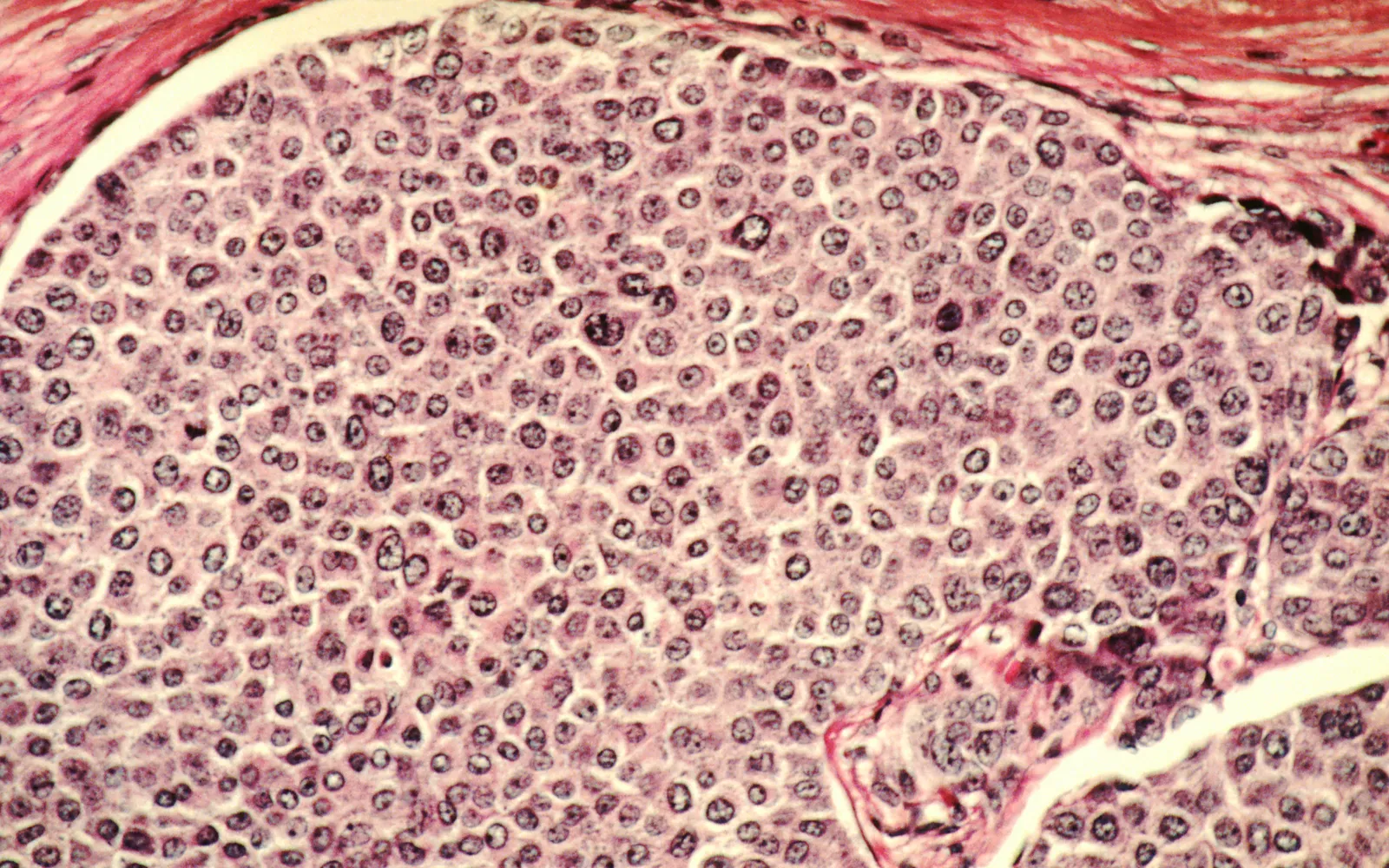
Some women with HER2 positive breast cancer can skip chemotherapy if their tumor responds early to targeted drugs alone, a five year update of a European trial suggests. Of the 86 women in the PHERGain trial who never received chemotherapy, 92.4% were free of invasive disease five years after surgery, according to results published Oct 29 in Nature Medicine.
The authors flag the limit themselves. Those 86 women were picked after randomization, by how well they responded, so the 92.4% “should be interpreted as descriptive rather than as causal effects of omitting chemotherapy,” they write.
How the trial worked
PHERGain enrolled 376 women from June 2017 to April 2019 at 45 hospitals in Spain, France, Belgium, Germany, the UK, Italy and Portugal. Each had HER2 positive breast cancer at stage I to IIIA, with a tumor of at least 1.5 centimeters. MEDSIR, a Barcelona research group, ran the trial (NCT03161353).
Group A, 71 women, got standard care: two chemotherapy drugs, docetaxel and carboplatin, plus the HER2 drugs trastuzumab and pertuzumab. Group B, 285 women, started on the two HER2 drugs alone, with hormone therapy if the tumor was hormone receptor positive.
After two cycles, group B had a PET scan. Women whose tumor activity fell by 40% or more stayed off chemotherapy. Those who didn’t respond switched to chemotherapy. Responders who still had invasive cancer at surgery got chemotherapy afterward.
The 5 year numbers
Median follow up was 5.6 years. Among the 267 women in group B who had surgery under the protocol:
- 89.5% were free of invasive disease at 5 years.
- 26 women, or 9.7%, had an invasive disease event or died.
- 5.2% had a distant recurrence, meaning the cancer spread.
In group A, 96.7% of 63 women were free of invasive disease at 5 years. The trial wasn’t built to compare the two groups. Women were assigned 1 to 4, so group A was small and served as a benchmark. Distant recurrences were “numerically more frequent” in group B, 5.2% against 3.2%, the authors write.
Among the 86 women who never got chemotherapy, one had a distant recurrence. Five years after randomization, 98.1% of group B and 98.4% of group A were alive.
A blood test signal
The paper adds a new analysis of tumor DNA in the blood, run on Guardant Health’s Guardant Reveal test. Of 288 women with a usable sample before treatment, 204, or 71%, had detectable tumor DNA.
When that DNA cleared after two cycles, 48.4% of women had no invasive cancer left at surgery. When it persisted, 22.0% did. None of the 28 women whose tumor DNA was still detectable just before surgery reached that result.
These blood test analyses were exploratory. The authors write that prospective validation is needed before doctors use tumor DNA to make treatment decisions.
What it means for patients
The results don’t change standard care. PHERGain is a phase 2 trial. Of the 250 group B women who finished the first 3 years, 35 did not sign up for the longer follow up. The authors list that dropout as a possible source of bias. Women without a full response at surgery also didn’t get trastuzumab emtansine, a drug approved for that setting after the trial began.
What the trial adds is evidence that a PET scan and a pathology result can sort out who responds to targeted drugs alone. The open question is how to pick those women before treatment starts. A 7 year analysis is planned.
Roche funded the trial and Guardant Health funded the tumor DNA tests. Many authors report payments from drugmakers, and several work for MEDSIR.
Related coverage
Doctors redrew women’s heart care across four life stages. The FDA approved the first generic Climara Pro menopause patch.


 HHS
 American Heart Association

 Federal Register