Severe birth complications rose 40.5% from 2015 to 2022
A JAMA Network Open study of 27.3 million US deliveries finds Medicaid patients had higher odds of severe complications in every racial and ethnic group, and nearly twice the odds of a related death.

The rate of severe complications at delivery rose 40.5%, from 175.0 to 245.9 per 10,000 deliveries, between 2015 and 2022, according to a study published Nov. 3 in JAMA Network Open.
Severe maternal morbidity, or SMM, means at least one of 21 serious complications defined by the CDC, such as sepsis, kidney failure, heart attack, eclampsia or blood transfusion. Researchers at the University of Calgary analyzed 27,341,986 weighted deliveries in the National Inpatient Sample, a 20% stratified sample of US hospital discharges. Of those, 563,250, or 2.1%, had SMM. The study covered delivery hospitalizations from Oct. 1, 2015 to Dec. 31, 2022. Sixteen of the 21 individual complications rose.
Medicaid births carry more risk
Medicaid covered 11,658,119 weighted deliveries, or 45.5%. After adjustment, Medicaid patients had 1.22 times the odds of SMM compared with privately insured patients. An odds ratio of 1.22 means 22% higher odds after adjusting for health and other factors. The odds of an SMM-related death were 1.96 times higher.
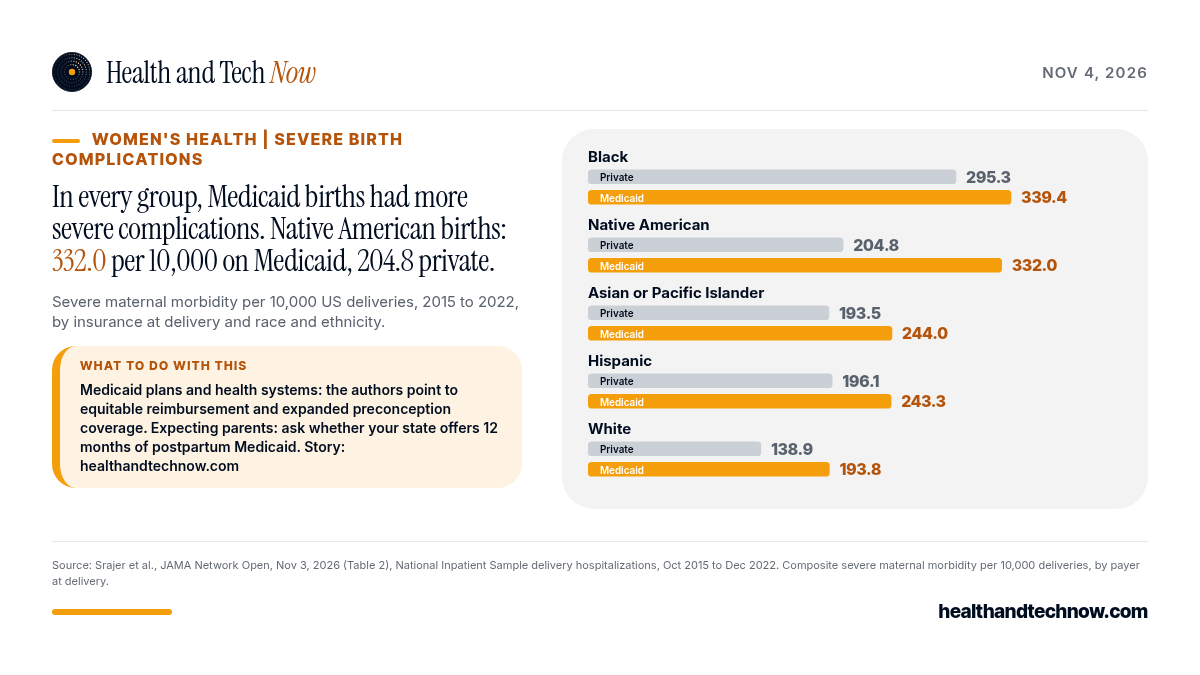
The pattern held within every racial and ethnic group. Adjusted odds ratios for Medicaid versus private insurance were 1.28 for Asian or Pacific Islander patients, 1.13 for Black patients, 1.29 for Hispanic patients, 1.44 for Native American patients and 1.23 for White patients.
Composite SMM per 10,000 deliveries, private versus Medicaid, were 193.5 versus 244.0 for Asian or Pacific Islander patients, 295.3 versus 339.4 for Black patients, 196.1 versus 243.3 for Hispanic patients, 204.8 versus 332.0 for Native American patients and 138.9 versus 193.8 for White patients.
The authors say the findings suggest “underlying structural inequities that accompany Medicaid coverage rather than a direct effect of insurance type.”
Which complications
Blood transfusion was the most common complication across the period, at 115.0 per 10,000 deliveries. Sepsis was 22.9 per 10,000 and disseminated intravascular coagulation was 20.5 per 10,000. Cardiac arrest or ventricular fibrillation carried the highest death risk: 35.0% of those cases ended in death, the study found.
Eclampsia was the only complication to fall, from 13.3 to 6.5 per 10,000.
What the study cannot show
The results show association, not cause. Payer was captured at delivery, and the data cover delivery hospitalizations only. The authors excluded 2023 because the National Inpatient Sample removed the race and ethnicity variable that year.
What to do with this
Expecting parents: know the warning signs of severe complications and talk to your doctor about them. Ask whether your state offers 12 months of postpartum Medicaid coverage, an option available under the American Rescue Plan Act since April 2022.
Health plans and Medicaid managed care: the authors call for “equitable reimbursement and expanded preconception coverage.” The study period ends near the start of the postpartum coverage option, and the authors say the results give a baseline to judge it.
Clinicians: blood transfusion, sepsis and clotting failure lead the list, and Medicaid patients carried higher odds in every group studied.


 HHS

 Nature
 American Heart Association