Medicare's fraud and payment checks saved $41.9 billion in fiscal 2025, up 59%
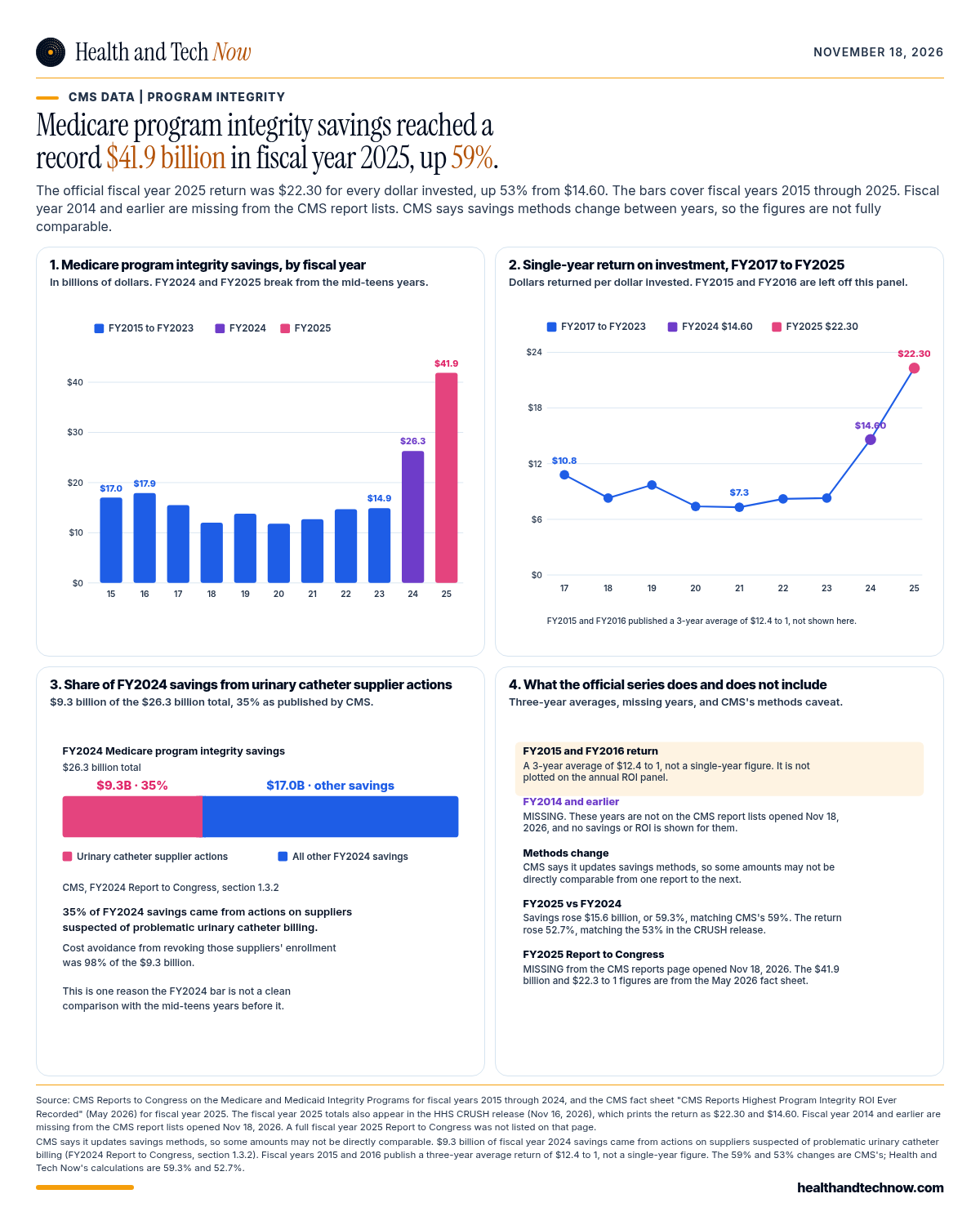
The official fiscal year 2025 return was $22.30 per $1 spent, up 53% from $14.60. The fiscal year 2024 jump is not a clean comparison with earlier years, because $9.3 billion of that year's $26.3 billion, or 35%, came from actions on urinary catheter suppliers.
The Centers for Medicare & Medicaid Services says its Medicare program integrity work saved $41.9 billion in fiscal year 2025, up 59% from $26.3 billion in fiscal year 2024. Program integrity savings are CMS’s official estimate of money kept in the Medicare trust funds by stopping fraud, waste, and improper payments. The figures come from a CMS fact sheet published in May 2026, and from CMS Reports to Congress for earlier years.
The official fiscal year 2025 return was $22.30 per $1 spent, up 53% from $14.60 in fiscal year 2024, according to an HHS press release dated Nov. 16, 2026. The May 2026 fact sheet prints the same totals as $22.3 to 1 and $14.6 to 1.
These yearly savings are not the same as the $90.2 billion in Medicare Advantage audit collections that CMS projects over 10 years in its CRUSH proposed rule. Health and Tech Now covered that proposed rule on Nov. 16.
Eleven years of official savings
CMS has published a Medicare program integrity savings total for each fiscal year from 2015 through 2025. The series stayed between $11.8 billion and $17.9 billion for most of that span, from $17.0 billion in fiscal year 2015 and $17.9 billion in fiscal year 2016, down to $11.8 billion in fiscal year 2020, then $14.9 billion in fiscal year 2023. It then rose to $26.3 billion in fiscal year 2024 and $41.9 billion in fiscal year 2025.
The $15.6 billion increase from fiscal year 2024 to fiscal year 2025 is 59.3% in Health and Tech Now’s math, which rounds to the 59% in the fact sheet.
CMS has said it periodically updates its savings methods, so totals in later reports may not be directly comparable with earlier years. That caveat appears in the fiscal year 2021 Report to Congress and is repeated in later reports, including a footnote in the fiscal year 2024 report.
Why fiscal year 2024 is not a clean comparison
The fiscal year 2024 Report to Congress says 35% of that year’s Medicare program integrity savings came from actions on suppliers suspected of problematic urinary catheter billing, or $9.3 billion. Cost avoidance from revocations accounted for 98% of the savings tied to those catheter suppliers.
The remaining $17.0 billion, by Health and Tech Now’s math, is 26.3 minus 9.3.
The official return
CMS published a single-year return beginning in fiscal year 2017. That yearly series runs from $10.8 per $1 in fiscal year 2017, down to $7.3 in fiscal year 2021, then $8.3 in fiscal year 2023, $14.60 in fiscal year 2024, and $22.30 in fiscal year 2025.
The 52.7% increase from $14.60 to $22.30, using the fact sheet’s one-decimal figures of $14.6 and $22.3, matches the 53% in the HHS release.
For fiscal years 2015 and 2016, CMS published a three-year average return of $12.4 to 1, not a single-year figure. Those two years are left off the annual return panel.
What is missing
Fiscal year 2014 and earlier totals are missing. They are not listed on the official CMS report index pages opened on Nov. 18, 2026.
A full fiscal year 2025 Report to Congress is also missing from those lists. The fiscal year 2025 totals used here come from the May 2026 fact sheet and the Nov. 16, 2026 HHS release.
How we did this: Every figure comes from a CMS Report to Congress for fiscal years 2015 through 2024, from the May 2026 fiscal year 2025 fact sheet, or from the Nov. 16, 2026 HHS press release. The $17.0 billion remainder, the $15.6 billion increase, and the 59.3% and 52.7% checks are Health and Tech Now math from those official totals. Fiscal year 2014 and earlier, and a full fiscal year 2025 Report to Congress, are missing.
 CMS fact sheet, CMS Reports Highest Program Integrity ROI Ever Recorded, published May 2026
 HHS press release, CMS CRUSH proposed rule, Nov. 16, 2026
- CMS, FY2024 Medicare and Medicaid Integrity Programs Report to Congress
- CMS, Medicare and Medicaid Integrity Programs Reports to Congress, fiscal years 2015 through 2023


 AMA