CMS fraud rule would raise Medicare Advantage audit collections to $90.2 billion over 10 years
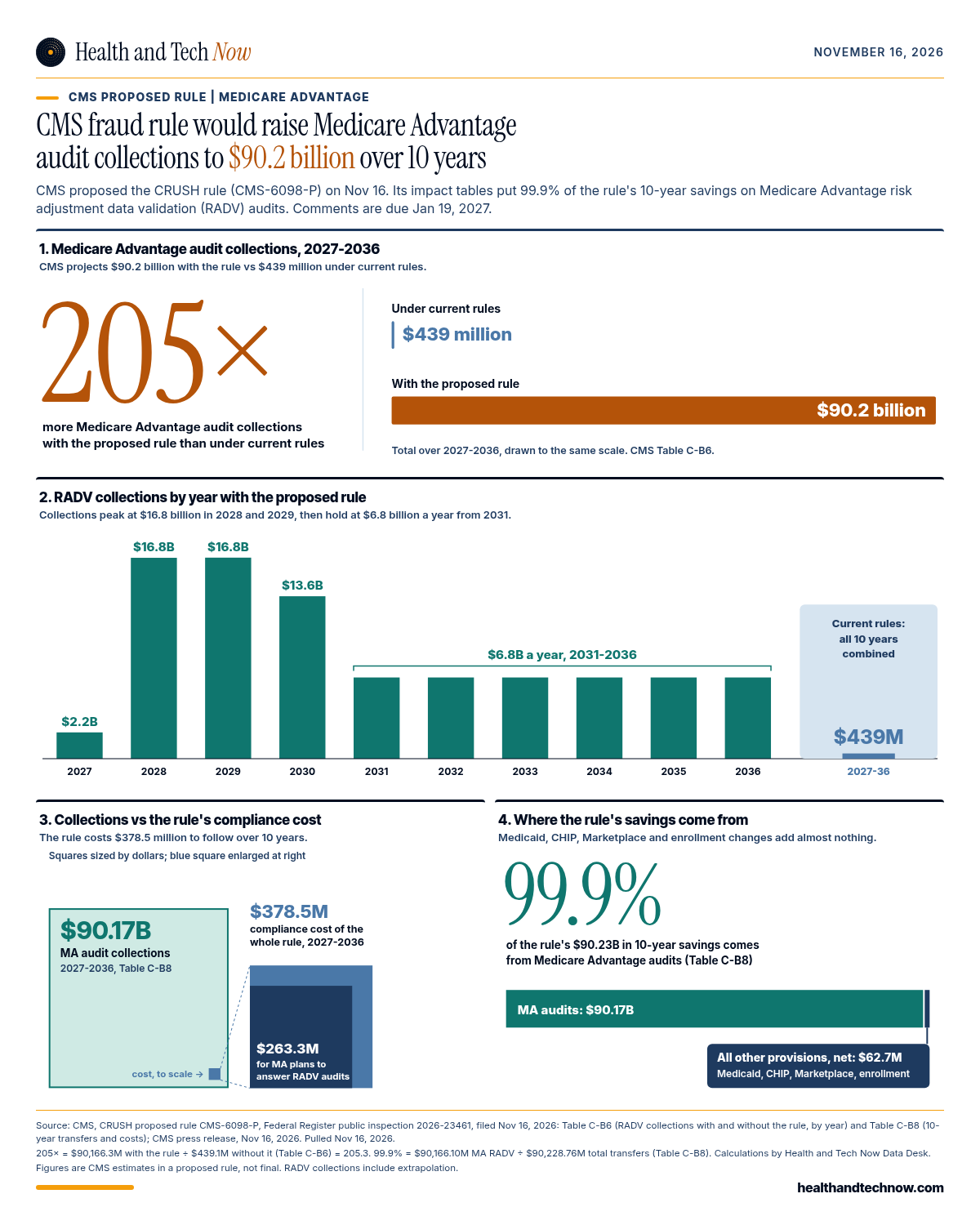
CMS's own impact tables put 99.9% of the CRUSH rule's 10-year savings on Medicare Advantage risk adjustment audits, 205 times what CMS expects to collect under current audit rules.

The Centers for Medicare & Medicaid Services (CMS) expects its new anti-fraud rule to collect $90.2 billion from Medicare Advantage plans over 10 years through risk adjustment data validation (RADV) audits. Under current audit rules, CMS expects to collect $439.1 million over the same years. That is 205 times more, by Health and Tech Now’s math from the rule’s impact tables.
CMS filed the proposed rule, called Comprehensive Regulations to Uncover Suspicious Healthcare (CRUSH) and numbered CMS-6098-P, for Federal Register public inspection on Nov 16 at 3:15 PM CT. It is scheduled for publication on Nov 19. Comments are due Jan 19, 2027, according to the HHS press release.
Where the money comes from
The rule covers Medicare, Medicaid, CHIP and the ACA Marketplace. Almost all of the savings come from one part of it. Table C-B8 puts total transfers at $90.23 billion over 10 years. Medicare Advantage RADV audits account for $90.17 billion of that, or 99.9%. Every other provision combined adds a net $62.7 million.
RADV audits check whether the diagnoses a plan reported to CMS are backed by medical records. Plans are paid more for sicker members, so unsupported diagnoses mean overpayments. The rule’s larger figure assumes CMS extrapolates audit findings across a contract instead of collecting only on the sampled records.
CMS projects collections of $2.2 billion in 2027, $16.8 billion in each of 2028 and 2029, and $13.6 billion in 2030. From 2031 through 2036, it projects $6.8 billion a year.
The rule’s estimate assumes 8,260 audited Medicare Advantage contracts over 2027 to 2036, about 826 a year, and an average overpayment of $1,258 per enrollee in each audit sample. CMS took the $1,258 from its audits of payment years 2011 to 2015.
What it costs plans
CMS puts the rule’s total compliance cost at $378.5 million over 10 years. Of that, $263.3 million is the cost for Medicare Advantage plans to answer RADV audits.
These are CMS estimates in a proposed rule. The final rule can change them.
 CMS, Comprehensive Regulations to Uncover Suspicious Healthcare (CRUSH) proposed rule, CMS-6098-P, Federal Register public inspection document 2026-23461, filed Nov 16, 2026 (Tables C-B6 and C-B8)
 CMS fact sheet, CRUSH proposed rule (CMS-6098-P), Nov 16, 2026
 HHS press release, CMS CRUSH proposed rule, Nov 16, 2026


 AMA