Medicare's 2027 rule still lowers the spending target for 31 of 107 doctor groups
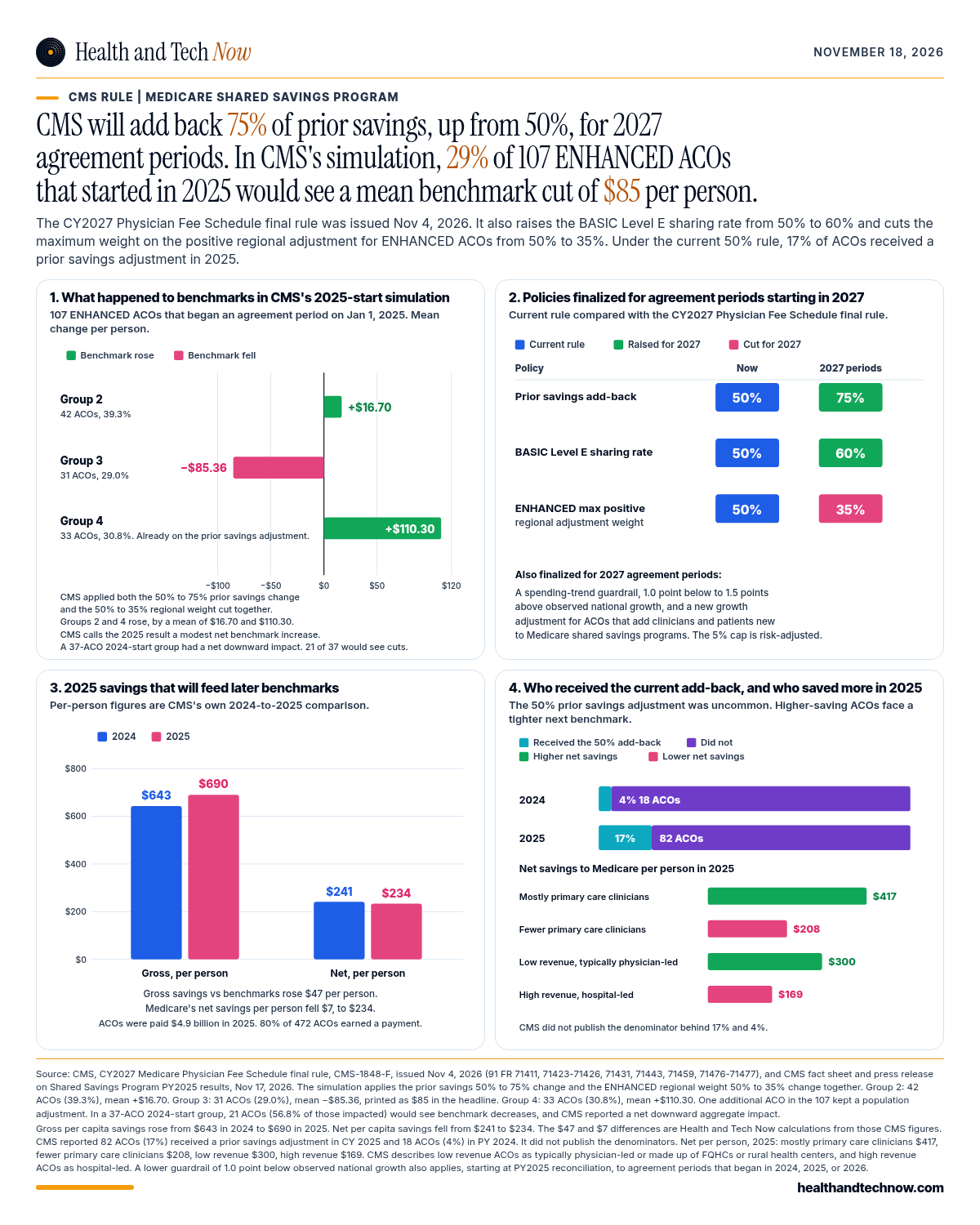
ACOs are doctor and hospital groups that earn a bonus when their Medicare patients cost less than a yearly spending target. CMS tested its 2027 changes on 107 groups that take on the most financial risk. 31 of them, or 29%, still saw that target fall, by $85 per person on average, which makes the bonus harder to earn.

The Centers for Medicare & Medicaid Services will add back 75% of prior savings, up from 50%, for agreement periods that begin on Jan. 1, 2027. That change is in the 2027 Physician Fee Schedule final rule, published Nov. 9, 2026, and effective Jan. 1, 2027.
In the same rule, CMS published a simulation of 107 ENHANCED track ACOs that began an agreement period on Jan. 1, 2025. After both the higher prior savings adjustment and a cut in the maximum positive regional weight from 50% to 35%, 31 of those ACOs, or 29%, still had a mean benchmark cut of $85 per person. CMS reported that mean as $85.36.
Groups 2 and 4 rose, by a mean of $16.70 and $110.30. CMS calls the 2025 result a modest net benchmark increase.
What the 107 ACO simulation shows
The simulation is limited to ENHANCED track ACOs with lower spending than their regional service area. It applies the two policy changes together. CMS first reported it in the proposed rule and restated the results at 91 FR 71425, including Table B-G14.
Of the 107 ACOs:
- 42 ACOs, or 39.3%, saw benchmarks rise by a mean of $16.70. These are Group 2.
- 33 ACOs, or 30.8%, were already on the prior savings adjustment. Their mean benchmark change was +$110.30. These are Group 4.
- 31 ACOs, or 29.0%, saw benchmarks fall by a mean of $85.36. These are Group 3.
- One ACO had the population adjustment as the applicable adjustment and would keep it.
42 plus 33 is 75, or 70.1% of the 107, the share for which prior savings would be the applicable adjustment. 42 plus 33 plus 31 plus 1 equals 107.
CMS said the increase in the prior savings scaling more than offsets the reduction in the regional weight in aggregate, producing a modest net benchmark increase concentrated among ACOs with proven savings records.
The group that started in 2024 moved the other way
CMS also simulated 37 ENHANCED track ACOs that began an agreement period on Jan. 1, 2024. In that group, 21 of 37 saw benchmark cuts. CMS said the combined effect produces a net downward aggregate impact on benchmarks. 43.2% of that group would hold prior savings as the applicable adjustment.
Other benchmark changes in the same rule
The rule also raises the BASIC track Level E shared savings rate from 50% to 60% for agreement periods beginning on or after Jan. 1, 2027.
It cuts the maximum weight on the positive regional adjustment for ENHANCED track ACOs from 50% to 35%.
It applies risk adjustment to the 5% cap on upward benchmark adjustments, for agreement periods beginning Jan. 1, 2027, and later.
It adds a growth adjustment to the historical benchmark, finalized as proposed, at 42 CFR 425.664.
For the Accountable Care Prospective Trend, the modified growth rate may not be more than 1.0 percentage point below or 1.5 percentage points above observed national growth, with thresholds rounded to the nearest tenth of a percentage point. CMS corrected the upper test to “greater than +1.5” rather than “greater than or equal to +1.5.” A lower guardrail of 1.0 percentage point also applies to agreement periods that began in 2024, 2025, or 2026, starting at 2025 reconciliation.
How often the current prior savings adjustment is used
Under the current 50% prior savings adjustment, 82 ACOs, or 17%, received it in calendar year 2025, and 18 ACOs, or 4%, received it in performance year 2024, the rule says. CMS did not publish the denominators behind those shares.
The 2025 results that will feed later benchmarks
CMS said Nov. 17 that Shared Savings Program ACOs earned $4.9 billion in shared savings payments for 2025 and Medicare saved $2.5 billion. Gross savings per assigned beneficiary rose from $643 in 2024 to $690 in 2025. Medicare’s net savings per beneficiary fell from $241 to $234.
ACOs made up mostly of primary care clinicians saved Medicare $417 per beneficiary. ACOs with fewer primary care clinicians saved $208. Low revenue ACOs saved $300. High revenue ACOs saved $169. 80% of 472 ACOs earned payments.
Those 2025 results were reported in a Nov. 17 story. This page covers the 2027 benchmark method changes and CMS’s simulation, which that page does not.
How we did this: Every figure comes from the CY2027 Physician Fee Schedule final rule, CMS-1848-F, at 91 FR 71424 through 71426 and Table B-G14, or from the CMS Shared Savings Program fact sheet and press release of Nov. 17, 2026. The $85 headline rounds CMS’s published mean of $85.36. CMS did not publish a program-wide dollar estimate of how much of the $4.9 billion or $2.5 billion would be added back to later benchmarks. The denominators behind the 17% and 4% uptake shares are also unpublished. A broader Group 5 cohort appears in Table B-G14 and is not part of the 107 ACO or 37 ACO simulations shown here.
 CY2027 Medicare Physician Fee Schedule final rule, CMS-1848-F, 91 FR 70992 through 91 FR 72020, published Nov. 9, 2026
 CMS fact sheet, Shared Savings Program ACOs PY2025 Financial and Quality Results, Nov. 17, 2026
- CMS press release, Medicare Shared Savings Program Saves More Than $2.5 Billion, Nov. 17, 2026


 AMA