Milliman: about 4.6 million Medicare Advantage members face specialist copays of $50 or more in 2027
Julia Friedman's Milliman MACVAT v1.1 analysis finds 44% of 18.4 million members in continuing Non-SNP plans got a higher specialist copay. Professional benefit value fell 9%.
About 4.6 million Medicare Advantage members are in plans charging $50 or more for a specialist visit in 2027. That is up from about 2.9 million in 2026. Health and Tech Now worked out those counts from shares that Julia Friedman posted on LinkedIn on Nov. 17.
Friedman is a Milliman principal and consulting actuary who leads its MACVAT product, and her figures come from the Milliman MACVAT 2027 data matrix v1.1.
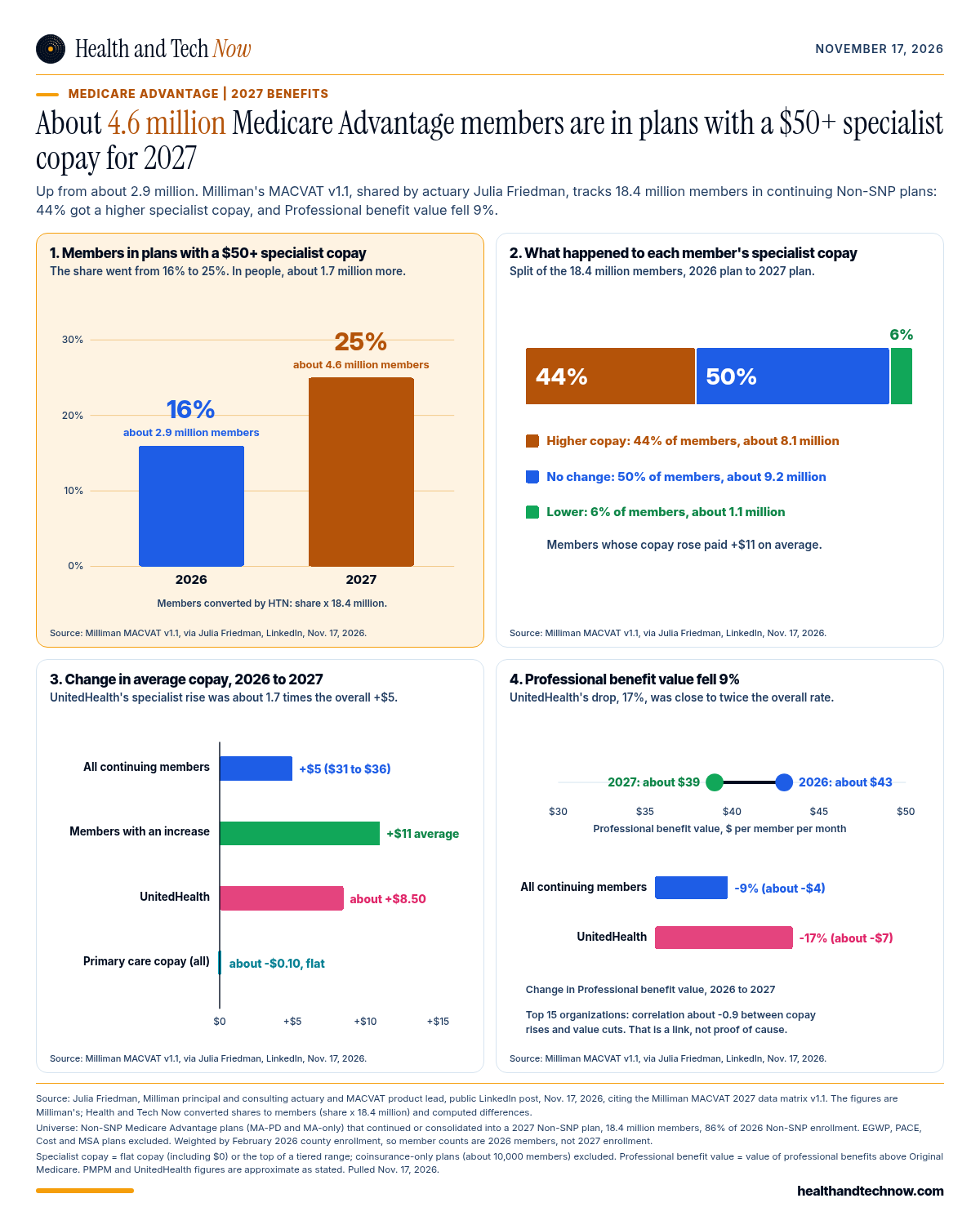
In Friedman’s post, the share of members in plans with a specialist copay of $50 or more rose from 16% to 25%. Applied to the 18.4 million members she tracked, that is about 1.7 million more people at that level. The member counts are our math on her stated shares, not figures Milliman published.
Her group is Non-SNP Medicare Advantage plans, MA-PD and MA-only, that continued or consolidated into a 2027 Non-SNP plan. That covers 18.4 million members, or 86% of 2026 Non-SNP enrollment, per the post. Employer group (EGWP), PACE, Cost and MSA plans are excluded.
The average specialist copay went from $31 to $36, Friedman wrote. Among members, 44% saw an increase averaging $11, half saw no change and 6% saw a decrease, according to the post.
Primary care copays barely moved. Friedman wrote that the average primary care copay fell by about 10 cents, which she called flat. She added that organizations tend to keep that copay at $0.
Milliman also measures Professional benefit value, the value of professional benefits above what Original Medicare covers. Friedman wrote that it fell from about $43 to $39 per member per month, down 9%. Specialist copays are a large driver of that measure but not all of it, she wrote.
Friedman named one organization, UnitedHealth. She wrote that it raised its average specialist copay by about $8.50 and that its Professional value fell by about $7, or 17%.
By our math, that copay rise is about 1.7 times the overall $5 increase. The value drop is close to twice the overall 9% (source: Friedman post).
Across the 15 largest organizations, Friedman reported a correlation of about negative 0.9 between specialist copay changes and Professional value changes. That means the two moved together in these plans. It does not show that copay changes caused the whole value decline.
The post gave no numbers for the other organizations.
The figures are weighted by 2026 members, using February 2026 county enrollment, per the post. So the member counts describe 2026 enrollment, not who will enroll in 2027.
Specialist copay means the flat copay, including $0, or the top of the range for tiered copays.
Plans with coinsurance only, about 10,000 members, are left out of the copay figures, Friedman wrote. MACVAT is a commercial Milliman tool, and Health and Tech Now could not inspect the underlying plan data. The post does not break the results down by state or county.
Credit: Julia Friedman of Milliman shared this analysis in a LinkedIn post on Nov. 17, 2026.

 CMS


 AMA