Medicare and Medicaid drove improper payments up to $112.9 billion in fiscal 2026
Improper payments are paid in the wrong amount or without the records to back them up. Health and Tech Now added CMS's six program estimates. The total rose $16.8 billion from fiscal 2025, led by Medicaid and Original Medicare.
The Centers for Medicare & Medicaid Services estimated $112.91 billion in improper payments across six programs for fiscal year 2026, up $16.76 billion, or 17.4%, from $96.15 billion in fiscal year 2025, according to the CMS fact sheet released Nov. 16, 2026. Health and Tech Now added the six program estimates to reach that total. CMS does not publish a combined figure in its fact sheet.
Original Medicare accounted for $33.96 billion at a rate of 7.32%, compared with 6.55% and $28.83 billion in fiscal year 2025. The fiscal year 2026 estimate marks the tenth straight year the rate has been below the 10% threshold set by improper payment law.
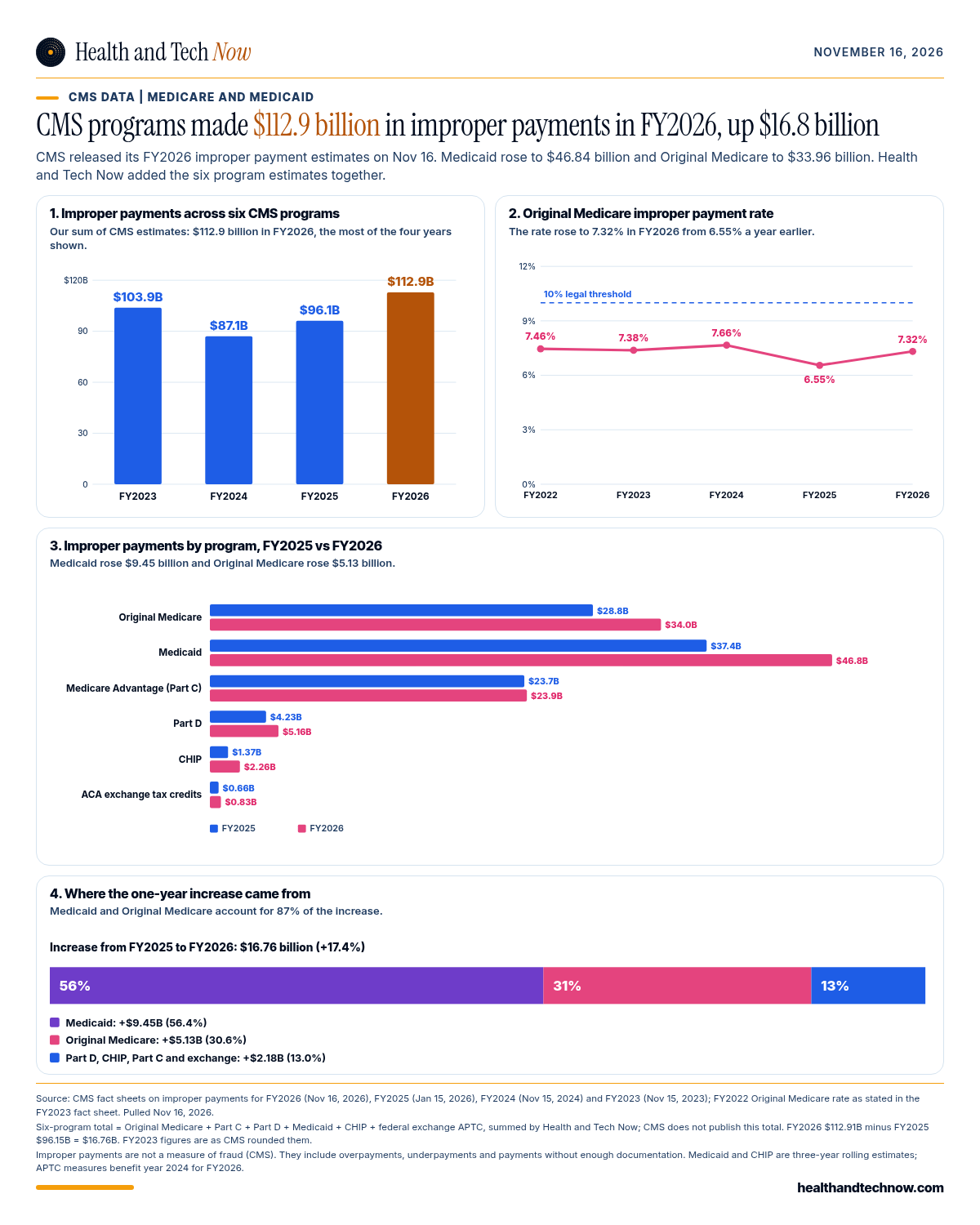
Medicare Part C, or Medicare Advantage, accounted for $23.86 billion at a rate of 5.68%, compared with 6.09% and $23.67 billion. Most Part C improper payments came from Medicare Advantage organizations whose supporting documentation did not substantiate beneficiary diagnosis data submitted for payment.
Medicare Part D accounted for $5.16 billion at a rate of 3.85%, compared with 4% and $4.23 billion.
Medicaid accounted for $46.84 billion at a rate of 7.08%, compared with 6.12% and $37.39 billion. The Medicaid estimate is composed of three review cycles of about 17 states each, from reviews in 2024, 2025 and 2026. About 79.41% of the improper payments resulted from insufficient documentation. Medicaid’s $9.45 billion increase is 56.4% of the combined rise, and Original Medicare’s $5.13 billion increase is 30.6%, by Health and Tech Now’s calculation.
CHIP accounted for $2.26 billion at a rate of 9.81%, compared with 7.05% and $1.37 billion. About 55.93% of CHIP improper payments resulted from insufficient documentation.
Advance premium tax credits for the ACA federal exchange in benefit year 2024 accounted for $830.37 million at a rate of 0.84%, compared with 0.89% and $657.46 million for benefit year 2023. The primary cause was overpayments from automated errors, mostly duplicate payment errors.
CMS says the Medicaid and CHIP increase partly reflects the end of COVID-19 public health emergency flexibilities, with eligibility redeterminations and provider revalidation requirements resuming in April 2023.
CMS says improper payment rates do not measure fraud. The figures include overpayments, underpayments and payments without enough information to determine whether requirements were met. CMS says most improper payments occurred where a reviewer could not determine whether a payment was proper because of insufficient documentation from a state, provider, Medicare Advantage organization, Part D sponsor or Marketplace insurer.
The Original Medicare and Medicaid and CHIP measurements use claims submitted from July 1, 2024 through June 30, 2025, before many current CMS anti-fraud efforts. CMS expects those efforts to appear in fiscal year 2027 data, with larger effects in fiscal year 2028. On the same day, CMS proposed its CRUSH anti-fraud rule, CMS-6098-P.
Documentation is the main cause CMS gives for Part C and Medicaid. Most Part C improper payments came from plan records that did not support diagnosis data, and about 79.41% of Medicaid improper payments came from insufficient documentation. Health and Tech Now’s earlier six program sums of CMS fact sheets were $87.08 billion for fiscal year 2024 and $103.87 billion for fiscal year 2023.
The HHS fiscal year 2026 Agency Financial Report, which carries the full improper payment detail, was not available to Health and Tech Now when this story was published. The figures here come from the CMS fact sheets.



 AMA